OnTheRice · News Degrees
A call from space proves contact, not a research result
Follow two records from the same mission, then see what a confirmed transfer of research data looks like.
What do a space station handover and a call to Islamabad prove about Pakistan’s first human spaceflight?
Degrees count the stories between the endpoints. Strength tells you how well the evidence supports each link.
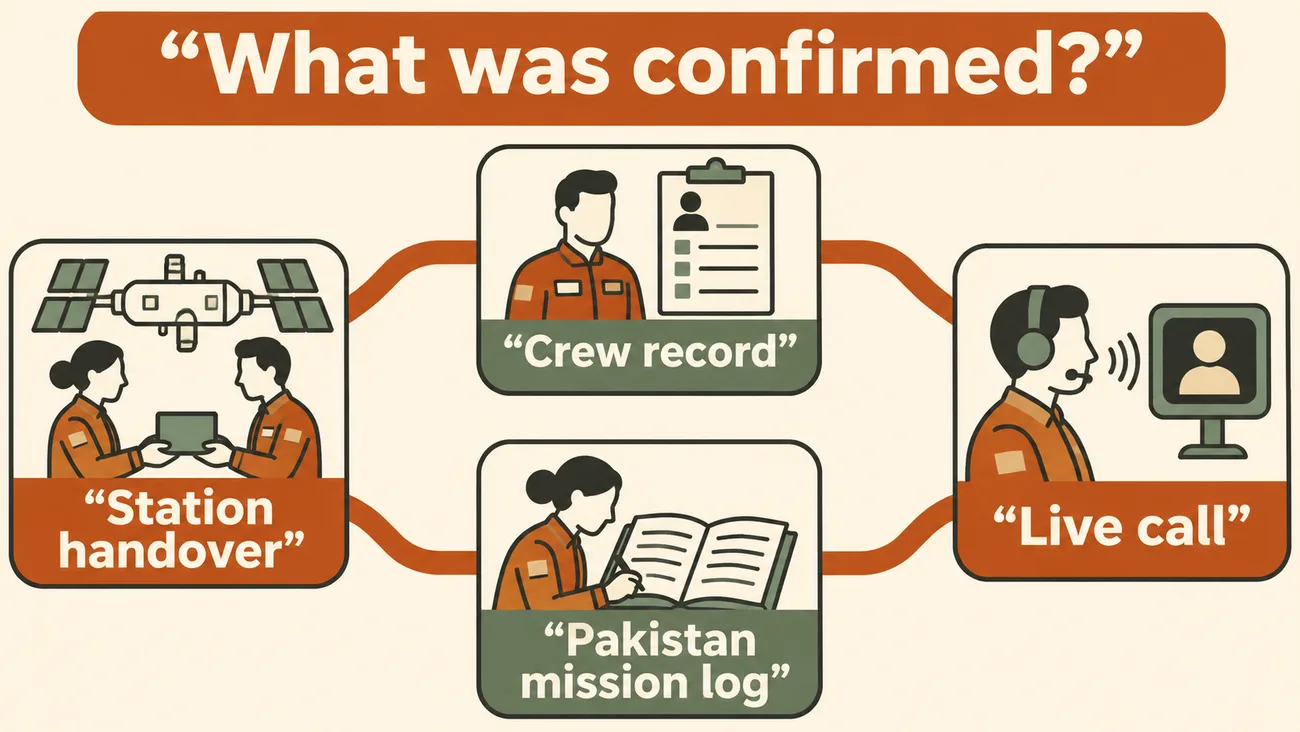
Read the image as text
The endpoints are the station handover and the live call. The upper path uses the Chinese crew record. The lower path uses the Pakistan mission log. Neither path shows a specific research result.
Documented (solid) Unproven (dashed)
01 · Read the records
Crews hand over the station key
28 November 2026, Beijing date only
China’s space agency says the Shenzhou-23 and Shenzhou-24 crews exchanged the station key on 28 November. It says Ali and the other two returning astronauts completed their assigned tasks. It does not name an experiment, sample, data file or finding.
The agency confirmed the station handover and reported task completion at mission level. It did not report an actual landing or a named result.
Pakistan confirms a live call
28 November 2026, Pakistan date only
Prime Minister Shehbaz Sharif spoke live from SUPARCO’s Islamabad headquarters to Ali aboard Tiangong.
It confirms contact with the astronaut, not what any research found.
China names the crew and logs entry
25 November 2026, 14:35 Beijing time
The briefing named Ali on Shenzhou-24; China later recorded that crew entering Tiangong.
The named crew and station entry connect the two later events without guessing their order.
Pakistan names the same flight
25 November 2026, 05:18 Pakistan time (launch)
SUPARCO logs flight PK-CSS-001, Shenzhou-24 to Tiangong, with Ali as the payload specialist.
Pakistan’s own mission identifier provides a separate way to match the live call to the flight.
A separate satellite mission launches
3 May 2024, date only
iCube-Qamar launched aboard Chang’e-6. Pakistani and Chinese institutions helped develop the satellite.
This was a separate, uncrewed lunar research path, not part of Shenzhou.
Satellite data reaches Pakistan
10 May 2024, date only
China’s space agency transferred iCube-Qamar data to Pakistan’s ambassador and unveiled its first image.
A named delivery is stronger evidence of research output reaching its recipient than launch or contact alone.
02 · Where the evidence stops
- Supports the chain
- China’s crew record and Pakistan’s mission log identify Muhammad Zeeshan Ali on Shenzhou-24 at Tiangong. The two governments separately recorded an in-orbit handover and a live call on 28 November.
- Weakens the chain
- The Chinese agency says returning crew completed their assigned tasks, but its 28 November notice names no specific scientific output. Both 28 November records are date-only; their order is unknown.
- Still missing
- No dated public receipt for a named sample or dataset from this mission, and no specific result verified in these sources.

Read the image as text
The visit and call establish access. A named data or sample receipt would establish delivery. A published record with methods and results would establish a finding. A separate 2024 satellite mission provides an actual data-handover example, not a result from this flight.
- 25 Nov, 14:35 Beijing timeShenzhou-24’s crew enters Tiangong.
- 28 Nov, date onlyStation handover and live call both confirmed. Their order that day is not established.
Evidence and sources for Read the mission records in order
- 25 Nov, 14:35 Beijing time Shenzhou-24’s crew enters Tiangong. · China Manned Space Agency · 2026-11-24: Shenzhou-24 mission briefing and named crew · China Manned Space Agency · 2026-11-25: Shenzhou-24 crew enters Tiangong
- 28 Nov, date only Station handover and live call both confirmed. Their order that day is not established. · China Manned Space Agency · 2026-11-28: Shenzhou-23 and Shenzhou-24 crews complete their in-orbit handover · Pakistan Press Information Department · 2026-11-28: Prime minister speaks live with Muhammad Zeeshan Ali aboard Tiangong
- Shenzhou, 2026Named astronaut and completed station milestones. No named data receipt verified.
- iCube-Qamar, 2024A named lunar satellite, an actual transfer of its data, and a first image. This is a different mission.
Evidence and sources for Contact and delivered data show different things
- Shenzhou, 2026 Named astronaut and completed station milestones. No named data receipt verified. · China Manned Space Agency · 2026-11-28: Shenzhou-23 and Shenzhou-24 crews complete their in-orbit handover · Pakistan Press Information Department · 2026-11-28: Prime minister speaks live with Muhammad Zeeshan Ali aboard Tiangong
- iCube-Qamar, 2024 A named lunar satellite, an actual transfer of its data, and a first image. This is a different mission. · SUPARCO · Date not stated: iCube-Qamar satellite mission · China National Space Administration · 2024-05-10: China delivers iCube-Qamar data to Pakistan
- Mission milestoneShare the confirmed handover or call.
- Research claimAsk for the named project, dated receipt and published finding before saying what the experiment showed.
- 30 November: check the scheduled returnIf the landing is delayed, wait for its dated result. Then look for a named data or sample receipt. Delivery is not a finding.
Evidence and sources for What can you say now?
- Mission milestone Share the confirmed handover or call. · China Manned Space Agency · 2026-11-28: Shenzhou-23 and Shenzhou-24 crews complete their in-orbit handover · Pakistan Press Information Department · 2026-11-28: Prime minister speaks live with Muhammad Zeeshan Ali aboard Tiangong
- Research claim Ask for the named project, dated receipt and published finding before saying what the experiment showed. · China Manned Space Agency · 2026-11-24: Shenzhou-24 mission briefing and named crew · China National Space Administration · 2024-05-10: China delivers iCube-Qamar data to Pakistan
- 30 November: check the scheduled return If the landing is delayed, wait for its dated result. Then look for a named data or sample receipt. Delivery is not a finding. · SUPARCO · Date not stated: SUPARCO mission dashboard, PK-CSS-001 and return schedule · China Manned Space Agency · 2026-11-28: Shenzhou-23 and Shenzhou-24 crews complete their in-orbit handover
03 · Story map
Map view
Main path
1 pivot · 2 links · China names the crew and logs entry
- Documented: Crews hand over the station key → China names the crew and logs entryPivot 1: China names the crew and logs entry
- Documented: China names the crew and logs entry → Pakistan confirms a live call
Alternate path
1 pivot · 2 links · Pakistan names the same flight
- Documented: Crews hand over the station key → Pakistan names the same flightPivot 1: Pakistan names the same flight
- Documented: Pakistan names the same flight → Pakistan confirms a live call
Main path
1 pivot · 2 links · China names the crew and logs entry
- Start Crews hand over the station key
Documented: Crews hand over the station key → China names the crew and logs entry
- Who and when
- China’s named Shenzhou-24 crew · 25–28 November 2026
- What the evidence shows
- The handover names Ali and fits the crew that entered Tiangong on 25 November.
- What it does not show
- This does not establish Ali’s landing.
- What weakens the link
- The 28 November handover time was not given.
- Next check
- Check the separate landing record.
- Pivot 1 China names the crew and logs entry
Documented: China names the crew and logs entry → Pakistan confirms a live call
- Who and when
- Muhammad Zeeshan Ali aboard Tiangong · 25–28 November 2026
- What the evidence shows
- The China-side crew record and Pakistan’s call report identify the same astronaut aboard the same station.
- What it does not show
- The call did not establish a research result.
- What weakens the link
- Neither notice supplies an exact time for the call and handover.
- Next check
- Look for a named research record.
- China Manned Space Agency · 2026-11-24: Shenzhou-24 mission briefing and named crew
- China Manned Space Agency · 2026-11-25: Shenzhou-24 crew enters Tiangong
- Pakistan Press Information Department · 2026-11-28: Prime minister speaks live with Muhammad Zeeshan Ali aboard Tiangong
- Dawn · 2026-11-28: Live call with Muhammad Zeeshan Ali aboard Tiangong
- China Manned Space Agency · 2026-11-28: China verifies the Pakistan space-to-ground call
- End Pakistan confirms a live call
Alternate path
1 pivot · 2 links · Pakistan names the same flight
- Start Crews hand over the station key
Documented: Crews hand over the station key → Pakistan names the same flight
- Who and when
- Shenzhou-24 and Pakistan flight PK-CSS-001 · 25–28 November 2026
- What the evidence shows
- Pakistan’s mission log independently identifies Ali’s outward craft and destination; China identifies Shenzhou-23 as his planned return craft.
- What it does not show
- The outward and return craft are different; a plan is not a landing.
- What weakens the link
- Pakistan’s mission log does not document China’s key exchange.
- Next check
- Match the return notice to the named crew.
- Pivot 1 Pakistan names the same flight
Documented: Pakistan names the same flight → Pakistan confirms a live call
- Who and when
- SUPARCO’s mission and live call · 25–28 November 2026
- What the evidence shows
- SUPARCO identifies Ali’s flight to Tiangong; Pakistan’s press office confirms contact with him there.
- What it does not show
- This is evidence of mission access, not data delivery.
- What weakens the link
- The mission page does not provide a project-level receipt.
- Next check
- Check for a named recipient and dated delivery.
- SUPARCO · Date not stated: SUPARCO mission dashboard, PK-CSS-001 and return schedule
- Pakistan Press Information Department · 2026-11-28: Prime minister speaks live with Muhammad Zeeshan Ali aboard Tiangong
- Dawn · 2026-11-28: Live call with Muhammad Zeeshan Ali aboard Tiangong
- China Manned Space Agency · 2026-11-28: China verifies the Pakistan space-to-ground call
- End Pakistan confirms a live call
Read view
Main path
1 pivot · 2 links · China names the crew and logs entry
Documented: Crews hand over the station key → China names the crew and logs entry
- Who and when
- China’s named Shenzhou-24 crew · 25–28 November 2026
- What the evidence shows
- The handover names Ali and fits the crew that entered Tiangong on 25 November.
- What it does not show
- This does not establish Ali’s landing.
- What weakens the link
- The 28 November handover time was not given.
- Next check
- Check the separate landing record.
Documented: China names the crew and logs entry → Pakistan confirms a live call
- Who and when
- Muhammad Zeeshan Ali aboard Tiangong · 25–28 November 2026
- What the evidence shows
- The China-side crew record and Pakistan’s call report identify the same astronaut aboard the same station.
- What it does not show
- The call did not establish a research result.
- What weakens the link
- Neither notice supplies an exact time for the call and handover.
- Next check
- Look for a named research record.
- China Manned Space Agency · 2026-11-24: Shenzhou-24 mission briefing and named crew
- China Manned Space Agency · 2026-11-25: Shenzhou-24 crew enters Tiangong
- Pakistan Press Information Department · 2026-11-28: Prime minister speaks live with Muhammad Zeeshan Ali aboard Tiangong
- Dawn · 2026-11-28: Live call with Muhammad Zeeshan Ali aboard Tiangong
- China Manned Space Agency · 2026-11-28: China verifies the Pakistan space-to-ground call
Alternate path
1 pivot · 2 links · Pakistan names the same flight
Documented: Crews hand over the station key → Pakistan names the same flight
- Who and when
- Shenzhou-24 and Pakistan flight PK-CSS-001 · 25–28 November 2026
- What the evidence shows
- Pakistan’s mission log independently identifies Ali’s outward craft and destination; China identifies Shenzhou-23 as his planned return craft.
- What it does not show
- The outward and return craft are different; a plan is not a landing.
- What weakens the link
- Pakistan’s mission log does not document China’s key exchange.
- Next check
- Match the return notice to the named crew.
Documented: Pakistan names the same flight → Pakistan confirms a live call
- Who and when
- SUPARCO’s mission and live call · 25–28 November 2026
- What the evidence shows
- SUPARCO identifies Ali’s flight to Tiangong; Pakistan’s press office confirms contact with him there.
- What it does not show
- This is evidence of mission access, not data delivery.
- What weakens the link
- The mission page does not provide a project-level receipt.
- Next check
- Check for a named recipient and dated delivery.
- SUPARCO · Date not stated: SUPARCO mission dashboard, PK-CSS-001 and return schedule
- Pakistan Press Information Department · 2026-11-28: Prime minister speaks live with Muhammad Zeeshan Ali aboard Tiangong
- Dawn · 2026-11-28: Live call with Muhammad Zeeshan Ali aboard Tiangong
- China Manned Space Agency · 2026-11-28: China verifies the Pakistan space-to-ground call
Research workspace
How the Evidence Connects
- Crews hand over the station key → China names the crew and logs entry (Documented): The handover names Ali and fits the crew that entered Tiangong on 25 November. Limit: This does not establish Ali’s landing.
- China names the crew and logs entry → Pakistan confirms a live call (Documented): The China-side crew record and Pakistan’s call report identify the same astronaut aboard the same station. Limit: The call did not establish a research result.
- China Manned Space Agency · 2026-11-24: Shenzhou-24 mission briefing and named crew
- China Manned Space Agency · 2026-11-25: Shenzhou-24 crew enters Tiangong
- Pakistan Press Information Department · 2026-11-28: Prime minister speaks live with Muhammad Zeeshan Ali aboard Tiangong
- Dawn · 2026-11-28: Live call with Muhammad Zeeshan Ali aboard Tiangong
- China Manned Space Agency · 2026-11-28: China verifies the Pakistan space-to-ground call
Alternate: Crews hand over the station key → Pakistan names the same flight → Pakistan confirms a live call. The Chinese agency says returning crew completed their assigned tasks, but its 28 November notice names no specific scientific output. Both 28 November records are date-only; their order is unknown.
- Connection strength
- Documented through the same astronaut, spacecraft and station, not through a claim of cause and effect.
- Source credibility
- Two participant agencies document different events. Their records do not establish a scientific result.
- Reader relevance
- A call tells you someone reached you. A receipt tells you what arrived.
- Confidence
- High for the mission link and historical delivery; no confirmed finding from this flight.
OTR Emerging Data
The handover and the call confirm two steps in the same mission, not that one caused the other. A separate 2024 mission shows the kind of record that verifies data delivery.
What to check next
Check on 30 November after the planned return. SUPARCO lists 02:00 Pakistan time (05:00 Singapore time). If the schedule slips, wait for a dated landing notice. Then look for a record naming the project, what was received and who received it. A data receipt proves delivery; a published test with methods and results is a different record.
When sharing the story, say the mission reached these milestones. Do not call the research successful until there is evidence for a named result.
A dated handover of a named sample or dataset would establish delivery. It would not by itself prove what the experiment found.
Original sources
- China Manned Space Agency · 2026-11-28: Shenzhou-23 and Shenzhou-24 crews complete their in-orbit handover
- Pakistan Press Information Department · 2026-11-28: Prime minister speaks live with Muhammad Zeeshan Ali aboard Tiangong
- China Manned Space Agency · 2026-11-24: Shenzhou-24 mission briefing and named crew
- China Manned Space Agency · 2026-11-25: Shenzhou-24 crew enters Tiangong
- SUPARCO · Date not stated: SUPARCO mission dashboard, PK-CSS-001 and return schedule
- Dawn · 2026-11-28: Live call with Muhammad Zeeshan Ali aboard Tiangong
- SUPARCO · Date not stated: iCube-Qamar satellite mission
- China National Space Administration · 2024-05-10: China delivers iCube-Qamar data to Pakistan
- China Manned Space Agency · 2026-11-28: China verifies the Pakistan space-to-ground call