OnTheRice · News Degrees
Should you send cash or food? Check what’s missing first.
Find out what a grain order, a warehouse report and a cash transfer can actually prove.
When a hunger warning grows, should a relief partner send food, move food already in storage or help families pay?
Degrees count the stories between the endpoints. Strength tells you how well the evidence supports each link.
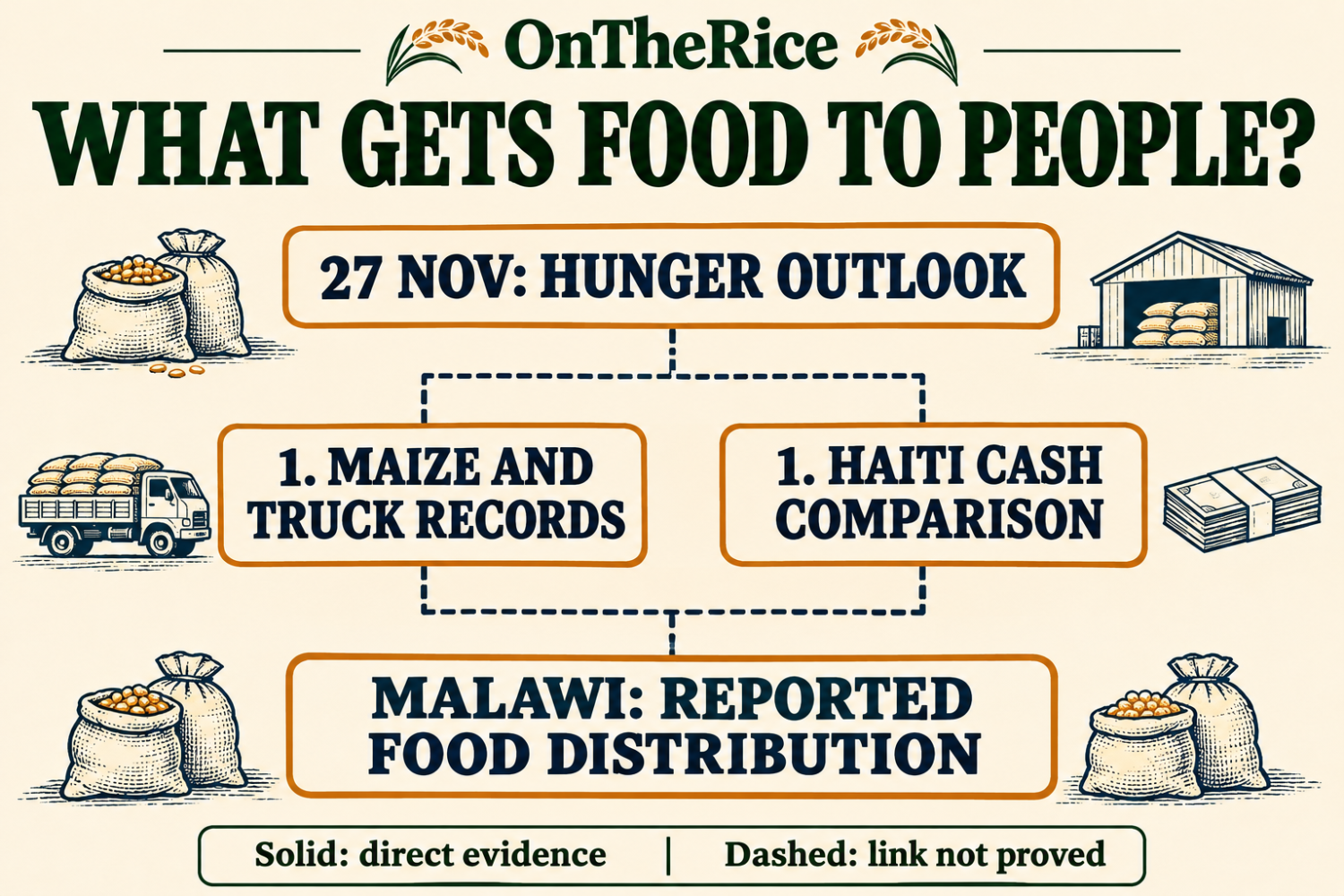
Read the image as text
Question: What gets food to people? Start: 27 November hunger outlook. End: Malawi’s earlier reported food distribution. Main route: through Malawi’s maize and truck records. Alternate: through Haiti’s earlier cash response. Each route has one pivot and two links. Solid means direct evidence. Dashed means the link is not proved. The original records can be documented while the connection between them remains unproven.
Documented (solid) Unproven (dashed)
01 · Read the records
The hunger outlook widens
27 November 2026 · original disclosure date only
FAO and WFP warned that hunger is likely to worsen in parts of Southern Africa and Central America from December to May. They project up to 2.6 million people in Malawi could face severe difficulty getting enough food through March.
This helps plan a response. It cannot tell you whether one district has food to buy or whether people can afford it.
Malawi’s maize and truck records
27 October 2025 · award notification; 13 November 2026 · public award; 26 November 2026 · plan update; dates only
The World Bank’s signed maize award lists 103,629.33 tonnes of non-GMO white maize for US$35.75 million. The updated plan also mentions 80,011.38 tonnes at Chipata in its narrative, beside the same rounded cost. Its detailed line and the signed award use about 103,629 tonnes. Road transport was separately awarded. The carrier notice describes GMO maize, unlike the non-GMO purchase, so we cannot match its load to this order.
These records can explain how to check an order and its movement. The public figures do not reconcile the lots. Do not add them, subtract one to estimate losses or treat the award as paid.
- World Bank · 2026-11-13: Signed maize award OP00481387; public record published 13 November
- World Bank · 2026-11-26: Procurement plan P508910, narrative and detailed table show different quantities
- Malawi National Food Reserve Agency · 2025-10-22: Malawi and Zambia: broader 200,000-tonne agreement
- World Bank · 2026-08-11: Separate Zambia-to-Malawi road transport award OP00461805, not a goods receipt
Haiti used cash before a storm
October 2025 · response took place before Hurricane Melissa; 3 November 2025 · report date only
WFP says about US$900,000 in advance cash reached roughly 50,000 people in Haiti before Melissa. The agency treated this as cash delivered, not food delivered.
This is another way to help where shops have food but buyers lack money. The report does not establish who bought which goods, at what price, or that the approach fits any Malawi district.
Malawi reported food distributed and food still stored
Earlier 2026 distribution; 15 October 2026 report dated only
The Nation quoted the Malawi government saying about 103,497 tonnes had arrived from Zambia, about 44,578 tonnes had been distributed and about 58,919 tonnes were still stored. These are the government’s figures in the October report, not a new warehouse count.
Arrival and release were not the same step in that account. It does not identify which lots are now cleared, how much is available for sale locally, or what a household will pay.
- The Nation, Malawi · 2026-10-15: Government account of earlier arrival, distribution and stock in storage
- The Nation, republished by Black News · 2026-10-15: Syndicated copy of the same 15 October report, not another source for the figures
- WFP Executive Board · 2026-06-15: 2025 loss register: 1,908 tonnes lost after grain quality problems on a separate route
- OnTheRice · 2026-11-26: OTR Learns: trace aid to the people and place served
02 · Where the evidence stops
- Supports the chain
- The November forecast, Malawi’s separate purchase and transport records, and October’s reported split between distributed and stored maize point to different bottlenecks. Haiti shows a separate route where WFP could report money reaching people before a crisis. Both routes have one pivot.
- Weakens the chain
- Not all national maize is usable or nearby. WFP recorded 1,908 tonnes of actual yellow-maize losses on a different route in 2025 when quality issues led to a warehouse hold. The different Malawi quantities cannot be joined at lot level. Haiti’s storm response does not prove the same payment or market conditions in Malawi.
- Still missing
- No current lot-matched district release, stock and selling price on the same day, household receipt or net settled supplier payment was independently verified. No original notice confirmed a 1 December opening at a named site.
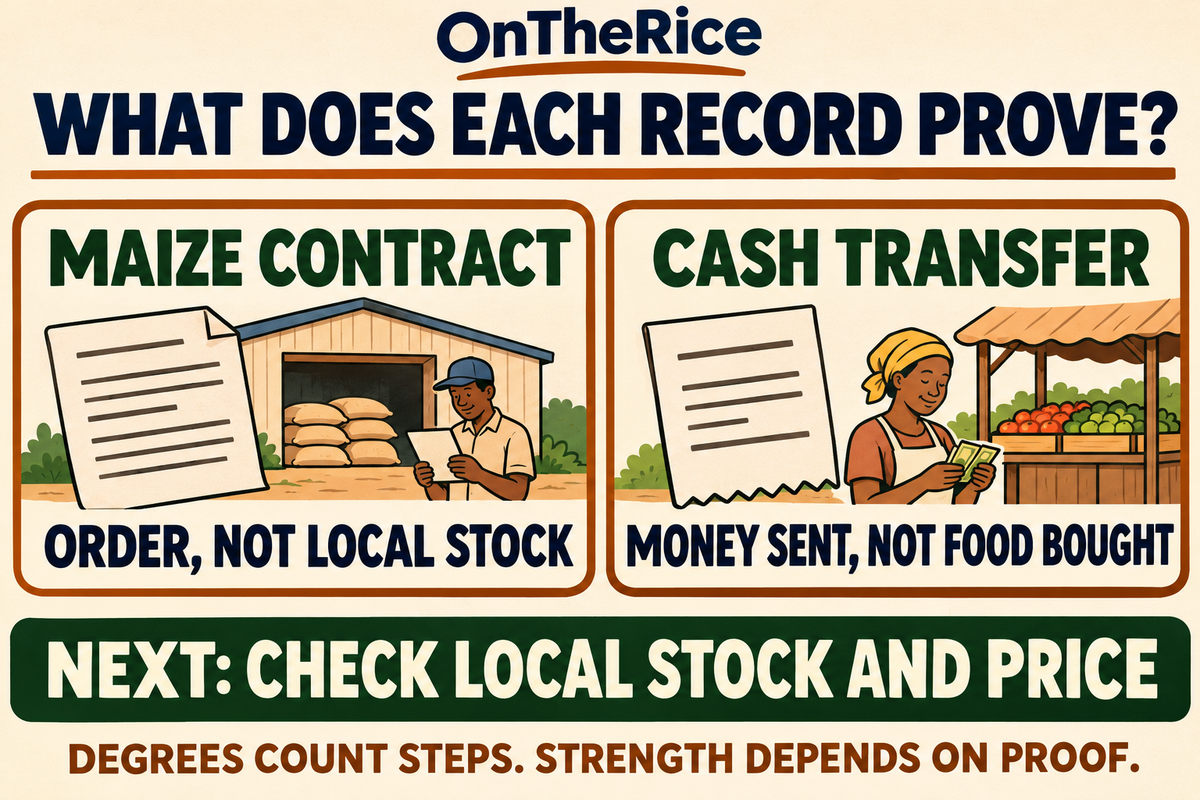
Read the image as text
What does each record prove? A maize contract shows an order, not stock in a local shop. A cash transfer shows money sent, not food bought. Next, check local stock and price. Degrees count steps; strength depends on proof.
- 22–27 October 2025Malawi’s reserve agency announced a 200,000-tonne framework. The narrower maize award’s notification is dated 27 October; this is not a delivery date.
- 15 October 2026The Nation reported the government’s account of earlier arrivals, distributions and stock held. This is the date of the account.
- 13 November 2026The older signed award became public. Publication is not the order’s signature or arrival date.
- 26 November 2026New procurement-plan publication. Its narrative and detailed award row use different quantities.
- 27 November 2026The joint hunger outlook described future risk for December through May, not food handed out.
Evidence and sources for Five dates, three different clocks
- 22–27 October 2025 Malawi’s reserve agency announced a 200,000-tonne framework. The narrower maize award’s notification is dated 27 October; this is not a delivery date. · Malawi National Food Reserve Agency · 2025-10-22: Malawi and Zambia: broader 200,000-tonne agreement · World Bank · 2026-11-13: Signed maize award OP00481387; public record published 13 November
- 15 October 2026 The Nation reported the government’s account of earlier arrivals, distributions and stock held. This is the date of the account. · The Nation, Malawi · 2026-10-15: Government account of earlier arrival, distribution and stock in storage
- 13 November 2026 The older signed award became public. Publication is not the order’s signature or arrival date. · World Bank · 2026-11-13: Signed maize award OP00481387; public record published 13 November
- 26 November 2026 New procurement-plan publication. Its narrative and detailed award row use different quantities. · World Bank · 2026-11-26: Procurement plan P508910, narrative and detailed table show different quantities · World Bank · 2026-11-13: Signed maize award OP00481387; public record published 13 November
- 27 November 2026 The joint hunger outlook described future risk for December through May, not food handed out. · World Food Programme and FAO · 2026-11-27: Hunger Hotspots outlook: forecast, not a count of households served · FAO · 2026-11-27: Same joint forecast: independent of the Malawi procurement file, not a second forecast
- 200,000 tonnesThe government-to-government supply amount announced in October 2025. Wider than the named signed World Bank award.
- 103,629.33 tonnesThe named signed order; its record does not say which household received a bag.
- 80,011.38 tonnesThe 26 November plan’s narrative describes maize at Chipata beside a similar amount in dollars. No lot-level reconciliation with the detailed award was found.
- About 44,578 and 58,919 tonnesThe October government account says about 44,578 tonnes were distributed and about 58,919 still stored. Do not treat that as fresh district inventory.
Evidence and sources for Do not make one total out of these tonnes
- 200,000 tonnes The government-to-government supply amount announced in October 2025. Wider than the named signed World Bank award. · Malawi National Food Reserve Agency · 2025-10-22: Malawi and Zambia: broader 200,000-tonne agreement · World Bank · 2026-11-13: Signed maize award OP00481387; public record published 13 November
- 103,629.33 tonnes The named signed order; its record does not say which household received a bag. · World Bank · 2026-11-13: Signed maize award OP00481387; public record published 13 November
- 80,011.38 tonnes The 26 November plan’s narrative describes maize at Chipata beside a similar amount in dollars. No lot-level reconciliation with the detailed award was found. · World Bank · 2026-11-26: Procurement plan P508910, narrative and detailed table show different quantities · World Bank · 2026-11-13: Signed maize award OP00481387; public record published 13 November
- About 44,578 and 58,919 tonnes The October government account says about 44,578 tonnes were distributed and about 58,919 still stored. Do not treat that as fresh district inventory. · The Nation, Malawi · 2026-10-15: Government account of earlier arrival, distribution and stock in storage
- Does the shop have stock, and can families afford it?If verified stock and a workable payment channel exist but families cannot afford the food, ask whether cash through a qualified partner is suitable. Check the price and actual access, not just the transfer.
- Is supply the missing step?If the outlet lacks stock and the depot has quality-cleared grain, ask for its signed release and the outlet’s dated receipt before paying for more stock or transport.
- Neither check passesDo not promise either intervention. On 1 December ask a local programme or market operator for a dated stock/price check; 1 December is a review point, not a confirmed opening.
Evidence and sources for What can a district partner verify today?
- Does the shop have stock, and can families afford it? If verified stock and a workable payment channel exist but families cannot afford the food, ask whether cash through a qualified partner is suitable. Check the price and actual access, not just the transfer. · WFP Executive Board · 2023-06-12: Cash policy paper: base the choice on how the market works · World Food Programme · 2025-11-03: After Melissa: operational report of advance payments in Haiti
- Is supply the missing step? If the outlet lacks stock and the depot has quality-cleared grain, ask for its signed release and the outlet’s dated receipt before paying for more stock or transport. · World Bank · 2026-11-26: Procurement plan P508910, narrative and detailed table show different quantities · The Nation, Malawi · 2026-10-15: Government account of earlier arrival, distribution and stock in storage · WFP Executive Board · 2026-06-15: 2025 loss register: 1,908 tonnes lost after grain quality problems on a separate route
- Neither check passes Do not promise either intervention. On 1 December ask a local programme or market operator for a dated stock/price check; 1 December is a review point, not a confirmed opening. · World Food Programme and FAO · 2026-11-27: Hunger Hotspots outlook: forecast, not a count of households served · WFP Executive Board · 2023-06-12: Cash policy paper: base the choice on how the market works
03 · Story map
Map view
Main path
1 pivot · 2 links · Malawi’s maize and truck records
- Unproven: The hunger outlook widens → Malawi’s maize and truck recordsPivot 1: Malawi’s maize and truck records
- Unproven: Malawi’s maize and truck records → Malawi reported food distributed and food still stored
Alternate path
1 pivot · 2 links · Haiti used cash before a storm
- Unproven: The hunger outlook widens → Haiti used cash before a stormPivot 1: Haiti used cash before a storm
- Unproven: Haiti used cash before a storm → Malawi reported food distributed and food still stored
Main path
1 pivot · 2 links · Malawi’s maize and truck records
- Start The hunger outlook widens
Unproven: The hunger outlook widens → Malawi’s maize and truck records
- Who and when
- FAO/WFP and Malawi’s National Food Reserve Agency · 27 November warning; older purchase and transport records
- What the evidence shows
- Malawi is named in the new forecast and in independently published maize procurement records. The award and transport files separate the physical steps.
- What it does not show
- No record shows this outlook caused the purchase, or that these older award lines can meet the new forecast.
- What weakens the link
- The award and plan contain different quantities on their face. Other stocks, purchases and partners may be involved.
- Next check
- Ask for one current district allocation with the lot identifier and total it can release, not the total national purchase.
- World Food Programme and FAO · 2026-11-27: Hunger Hotspots outlook: forecast, not a count of households served
- World Bank · 2026-11-13: Signed maize award OP00481387; public record published 13 November
- World Bank · 2026-11-26: Procurement plan P508910, narrative and detailed table show different quantities
- World Bank · 2026-08-11: Separate Zambia-to-Malawi road transport award OP00461805, not a goods receipt
- Pivot 1 Malawi’s maize and truck records
Unproven: Malawi’s maize and truck records → Malawi reported food distributed and food still stored
- Who and when
- Zambia FRA, Malawi NFRA and the government’s reported distribution · Award notice and October distribution account are separate clocks
- What the evidence shows
- The procurement trail has a dated grain award and a distinct haulage award. Malawi’s published account separately reported arrivals, distributions and stock in storage.
- What it does not show
- The public records do not match one award lot to a current district release or show that stored grain is ready to sell.
- What weakens the link
- WFP recorded actual quality losses on a different route in 2025; inspection can block supply after movement. That does not prove a problem with this maize.
- Next check
- Ask the depot to match its dispatch and quality release to the destination’s dated goods receipt.
- World Bank · 2026-11-13: Signed maize award OP00481387; public record published 13 November
- World Bank · 2026-11-26: Procurement plan P508910, narrative and detailed table show different quantities
- World Bank · 2026-08-11: Separate Zambia-to-Malawi road transport award OP00461805, not a goods receipt
- The Nation, Malawi · 2026-10-15: Government account of earlier arrival, distribution and stock in storage
- WFP Executive Board · 2026-06-15: 2025 loss register: 1,908 tonnes lost after grain quality problems on a separate route
- End Malawi reported food distributed and food still stored
Alternate path
1 pivot · 2 links · Haiti used cash before a storm
- Start The hunger outlook widens
Unproven: The hunger outlook widens → Haiti used cash before a storm
- Who and when
- WFP planning and its earlier Haiti response with local partners · 27 November 2026 forecast, compared with October 2025 Haiti action
- What the evidence shows
- The same food agency has used forecasts to release aid before a crisis. Haiti shows that money can reach people ahead of a shock when a cash channel works.
- What it does not show
- An alert does not start cash transfers and the current outlook does not pick a payment method for Malawi.
- What weakens the link
- The old Haiti result involved a fast-moving storm and a different payments and market arrangement, not Malawi’s slower lean season.
- Next check
- Get local shop stock and prices and check whether recipients can actually use the payment channel.
- World Food Programme and FAO · 2026-11-27: Hunger Hotspots outlook: forecast, not a count of households served
- World Food Programme · 2025-10-24: Haiti: anticipatory cash response as Melissa approached
- World Food Programme · 2025-11-03: After Melissa: operational report of advance payments in Haiti
- WFP Executive Board · 2023-06-12: Cash policy paper: base the choice on how the market works
- Pivot 1 Haiti used cash before a storm
Unproven: Haiti used cash before a storm → Malawi reported food distributed and food still stored
- Who and when
- Haiti cash route compared with Malawi’s earlier grain route · Haiti outcome reported 3 November 2025; Malawi account reported 15 October 2026
- What the evidence shows
- They are different kinds of completed steps reported by different actors: money transferred, and food reported distributed while more stayed in storage.
- What it does not show
- Neither source proves cash would buy enough food in Malawi, or that shipping grain would work faster in a district.
- What weakens the link
- A market can have food but prices people cannot afford. It can also have empty shelves even if cash arrives. A warehouse total alone cannot settle either case.
- Next check
- Check a named outlet’s same-day stock and price alongside the depot’s confirmed release. Use the result to choose which gap to address.
- World Food Programme · 2025-11-03: After Melissa: operational report of advance payments in Haiti
- The Nation, Malawi · 2026-10-15: Government account of earlier arrival, distribution and stock in storage
- WFP Executive Board · 2023-06-12: Cash policy paper: base the choice on how the market works
- OnTheRice · 2026-11-26: OTR Learns: trace aid to the people and place served
- End Malawi reported food distributed and food still stored
Read view
Main path
1 pivot · 2 links · Malawi’s maize and truck records
Unproven: The hunger outlook widens → Malawi’s maize and truck records
- Who and when
- FAO/WFP and Malawi’s National Food Reserve Agency · 27 November warning; older purchase and transport records
- What the evidence shows
- Malawi is named in the new forecast and in independently published maize procurement records. The award and transport files separate the physical steps.
- What it does not show
- No record shows this outlook caused the purchase, or that these older award lines can meet the new forecast.
- What weakens the link
- The award and plan contain different quantities on their face. Other stocks, purchases and partners may be involved.
- Next check
- Ask for one current district allocation with the lot identifier and total it can release, not the total national purchase.
- World Food Programme and FAO · 2026-11-27: Hunger Hotspots outlook: forecast, not a count of households served
- World Bank · 2026-11-13: Signed maize award OP00481387; public record published 13 November
- World Bank · 2026-11-26: Procurement plan P508910, narrative and detailed table show different quantities
- World Bank · 2026-08-11: Separate Zambia-to-Malawi road transport award OP00461805, not a goods receipt
Unproven: Malawi’s maize and truck records → Malawi reported food distributed and food still stored
- Who and when
- Zambia FRA, Malawi NFRA and the government’s reported distribution · Award notice and October distribution account are separate clocks
- What the evidence shows
- The procurement trail has a dated grain award and a distinct haulage award. Malawi’s published account separately reported arrivals, distributions and stock in storage.
- What it does not show
- The public records do not match one award lot to a current district release or show that stored grain is ready to sell.
- What weakens the link
- WFP recorded actual quality losses on a different route in 2025; inspection can block supply after movement. That does not prove a problem with this maize.
- Next check
- Ask the depot to match its dispatch and quality release to the destination’s dated goods receipt.
- World Bank · 2026-11-13: Signed maize award OP00481387; public record published 13 November
- World Bank · 2026-11-26: Procurement plan P508910, narrative and detailed table show different quantities
- World Bank · 2026-08-11: Separate Zambia-to-Malawi road transport award OP00461805, not a goods receipt
- The Nation, Malawi · 2026-10-15: Government account of earlier arrival, distribution and stock in storage
- WFP Executive Board · 2026-06-15: 2025 loss register: 1,908 tonnes lost after grain quality problems on a separate route
Alternate path
1 pivot · 2 links · Haiti used cash before a storm
Unproven: The hunger outlook widens → Haiti used cash before a storm
- Who and when
- WFP planning and its earlier Haiti response with local partners · 27 November 2026 forecast, compared with October 2025 Haiti action
- What the evidence shows
- The same food agency has used forecasts to release aid before a crisis. Haiti shows that money can reach people ahead of a shock when a cash channel works.
- What it does not show
- An alert does not start cash transfers and the current outlook does not pick a payment method for Malawi.
- What weakens the link
- The old Haiti result involved a fast-moving storm and a different payments and market arrangement, not Malawi’s slower lean season.
- Next check
- Get local shop stock and prices and check whether recipients can actually use the payment channel.
- World Food Programme and FAO · 2026-11-27: Hunger Hotspots outlook: forecast, not a count of households served
- World Food Programme · 2025-10-24: Haiti: anticipatory cash response as Melissa approached
- World Food Programme · 2025-11-03: After Melissa: operational report of advance payments in Haiti
- WFP Executive Board · 2023-06-12: Cash policy paper: base the choice on how the market works
Unproven: Haiti used cash before a storm → Malawi reported food distributed and food still stored
- Who and when
- Haiti cash route compared with Malawi’s earlier grain route · Haiti outcome reported 3 November 2025; Malawi account reported 15 October 2026
- What the evidence shows
- They are different kinds of completed steps reported by different actors: money transferred, and food reported distributed while more stayed in storage.
- What it does not show
- Neither source proves cash would buy enough food in Malawi, or that shipping grain would work faster in a district.
- What weakens the link
- A market can have food but prices people cannot afford. It can also have empty shelves even if cash arrives. A warehouse total alone cannot settle either case.
- Next check
- Check a named outlet’s same-day stock and price alongside the depot’s confirmed release. Use the result to choose which gap to address.
- World Food Programme · 2025-11-03: After Melissa: operational report of advance payments in Haiti
- The Nation, Malawi · 2026-10-15: Government account of earlier arrival, distribution and stock in storage
- WFP Executive Board · 2023-06-12: Cash policy paper: base the choice on how the market works
- OnTheRice · 2026-11-26: OTR Learns: trace aid to the people and place served
Research workspace
How the Evidence Connects
- The hunger outlook widens → Malawi’s maize and truck records (Unproven): Malawi is named in the new forecast and in independently published maize procurement records. The award and transport files separate the physical steps. Limit: No record shows this outlook caused the purchase, or that these older award lines can meet the new forecast.
- World Food Programme and FAO · 2026-11-27: Hunger Hotspots outlook: forecast, not a count of households served
- World Bank · 2026-11-13: Signed maize award OP00481387; public record published 13 November
- World Bank · 2026-11-26: Procurement plan P508910, narrative and detailed table show different quantities
- World Bank · 2026-08-11: Separate Zambia-to-Malawi road transport award OP00461805, not a goods receipt
- Malawi’s maize and truck records → Malawi reported food distributed and food still stored (Unproven): The procurement trail has a dated grain award and a distinct haulage award. Malawi’s published account separately reported arrivals, distributions and stock in storage. Limit: The public records do not match one award lot to a current district release or show that stored grain is ready to sell.
- World Bank · 2026-11-13: Signed maize award OP00481387; public record published 13 November
- World Bank · 2026-11-26: Procurement plan P508910, narrative and detailed table show different quantities
- World Bank · 2026-08-11: Separate Zambia-to-Malawi road transport award OP00461805, not a goods receipt
- The Nation, Malawi · 2026-10-15: Government account of earlier arrival, distribution and stock in storage
- WFP Executive Board · 2026-06-15: 2025 loss register: 1,908 tonnes lost after grain quality problems on a separate route
Alternate: The hunger outlook widens → Haiti used cash before a storm → Malawi reported food distributed and food still stored. Not all national maize is usable or nearby. WFP recorded 1,908 tonnes of actual yellow-maize losses on a different route in 2025 when quality issues led to a warehouse hold. The different Malawi quantities cannot be joined at lot level. Haiti’s storm response does not prove the same payment or market conditions in Malawi.
- Connection strength
- Useful comparison, not a proven causal link. Both paths have one intermediate record.
- Source credibility
- Original agency and World Bank records for the forecast and award; the Malawi distribution split is a reported government account. Haiti cash is operator-reported.
- Reader relevance
- High for relief buyers, donors and readers trying to distinguish warehouse and shop stock.
- Confidence
- High in the stated document stages. Lower about any one district today; no lot or price match.
OTR Emerging Data
The missing proof is different for each choice. Malawi’s older records suggest that paying to buy more grain could address the wrong step if usable stock is already held nearby. Haiti’s report shows cash can move early, but it does not put food on shelves. Choose based on what the named district lacks, not the largest national number. The historical cases inform the decision; neither predicts a local result.
What to check next
On 1 December, or before committing funds if sooner, ask the local partner for the named outlet’s stock and price that day and the lot’s signed quality release and arrival record. It is a check date, not an opening announcement.
For a donor or relief buyer: if the outlet has usable stock but families cannot pay, ask a qualified local partner about cash. If the outlet lacks stock but nearby grain cleared inspection, check whether transport or release is the missing step. If neither is confirmed, check with the local relief partner before promising either form of support. Do not delay an existing emergency response on the basis of this article.
A dated receipt showing that cleared grain reached the outlet and its selling price changes the logistics decision. If shops have stock but households still cannot afford it or cannot use the payment channel, the cash decision needs a new check. A new national estimate alone changes neither.
Original sources
- World Food Programme and FAO · 2026-11-27: Hunger Hotspots outlook: forecast, not a count of households served
- FAO · 2026-11-27: Same joint forecast: independent of the Malawi procurement file, not a second forecast
- World Bank · 2026-11-13: Signed maize award OP00481387; public record published 13 November
- World Bank · 2026-11-26: Procurement plan P508910, narrative and detailed table show different quantities
- Malawi National Food Reserve Agency · 2025-10-22: Malawi and Zambia: broader 200,000-tonne agreement
- World Bank · 2026-08-11: Separate Zambia-to-Malawi road transport award OP00461805, not a goods receipt
- The Nation, Malawi · 2026-10-15: Government account of earlier arrival, distribution and stock in storage
- The Nation, republished by Black News · 2026-10-15: Syndicated copy of the same 15 October report, not another source for the figures
- WFP Executive Board · 2026-06-15: 2025 loss register: 1,908 tonnes lost after grain quality problems on a separate route
- World Food Programme · 2025-10-24: Haiti: anticipatory cash response as Melissa approached
- World Food Programme · 2025-11-03: After Melissa: operational report of advance payments in Haiti
- WFP Executive Board · 2023-06-12: Cash policy paper: base the choice on how the market works
- OnTheRice · 2026-11-26: OTR Learns: trace aid to the people and place served