OnTheRice · News Degrees
A shipping warning is not a backup route
Before paying to move an order, check that a carrier can take it, what the full trip costs and when the goods can reach you.
Why link Hanoi’s new trade warning network to the day a Canadian fertiliser exporter pulled its sales offers?
Degrees count the stories between the endpoints. Strength tells you how well the evidence supports each link.
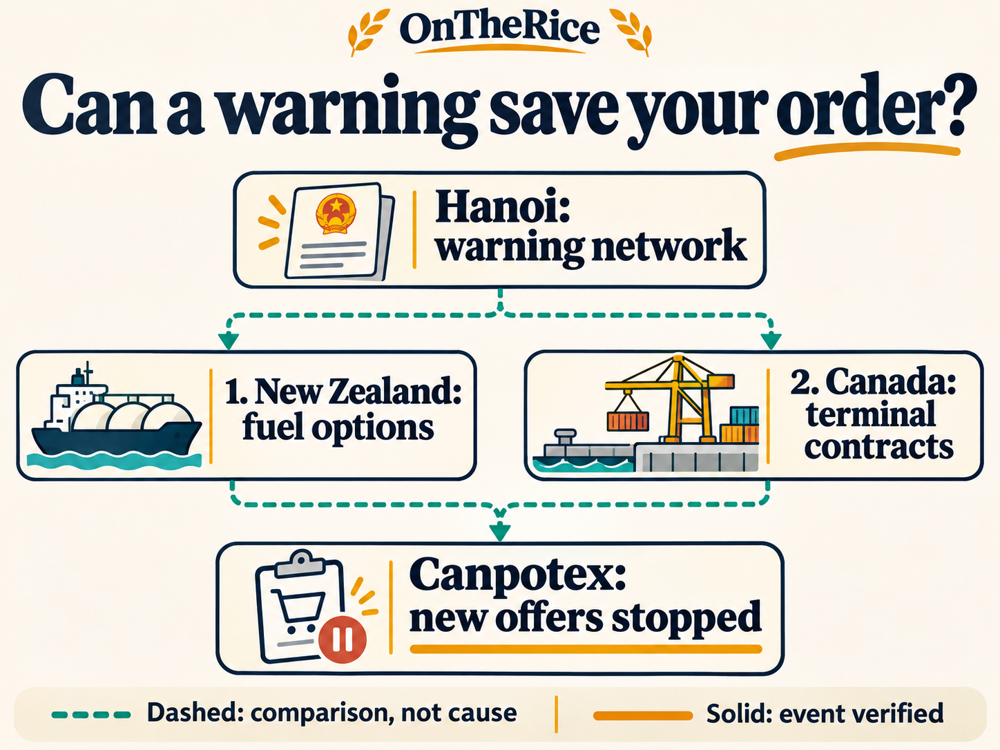
Read the image as text
The starting record is the Hanoi warning network launch on 26 November 2026. The main route compares it with New Zealand’s fuel options and a separate documented reserve shipment arrival. The alternate route compares it with long-term US terminal contracts reported around a Canadian port strike. Both meet the dated record: Canpotex withdrew new offers on 19 July 2023. Dashed lines mean these are comparisons, not proof of cause. The solid mark identifies the documented decision, not a confirmed link.
Documented (solid) Unproven (dashed)
01 · Read the records
EU and Pacific trade partners launch a warning network
26 Nov 2026, Hanoi; local coverage by 11:44 a.m. SGT
The European Union and the members of the Comprehensive and Progressive Agreement for Trans-Pacific Partnership launched a network for officials to spot threats, share information and coordinate responses. Its first meeting is planned for early 2027.
The network is real; a public route from its officials to a small business has not been verified.
- European Commission · 26 Nov 2026 (date only): Hanoi network launch and planned first meeting
- European Commission · 20 Nov 2025 (date only): First EU–CPTPP Trade and Investment Dialogue
- European Commission · Event scheduled for 15 Dec 2026, 15:00–16:30 CET; posting time not stated: Civil-society debrief on the Hanoi dialogue
- Báo Công Thương (Vietnam Industry and Trade newspaper) · 26 Nov 2026, 10:44 ICT (11:44 SGT); coverage time, not exact launch time: On-location photographs and report of the Hanoi morning meeting
- Austrian Parliament · Working paper created 15 Nov 2026, registered as received 16 Nov; dates only: Public register entry for the network terms-of-reference working paper WK 17757/26
New Zealand looks for fuel routes and separately buys reserve diesel
31 Mar to 7 Jul 2026; ministry review signed 29 Sep
New Zealand's foreign ministry reports that the Future of Investment and Trade Partnership identified alternate supply routes during a fuel disruption. In a separate national purchase, Z Energy had its first reserve shipment loaded on 31 May. Ministers confirmed it had reached Marsden Point by 7 July.
Identifying alternatives and confirming delivery are different steps. The public records do not tie the arrival to the partnership's route work.
- New Zealand Ministry of Foreign Affairs and Trade · 31 Mar 2026 (date only): FIT Partnership agrees to share information and coordinate disruption responses
- New Zealand Ministry of Foreign Affairs and Trade · Report signed 29 Sep 2026; precise online publication date not established: 2025–26 annual report, p. 30: partners identified alternate fuel supply routes
- New Zealand Government · 1 Jun 2026 (date only): First reserve diesel consignment loaded on 31 May
- New Zealand Government · 7 Jul 2026 (date only; exact arrival date not stated): Marsden Point tanks in use; first reserve diesel arrival confirmed
US terminals make longer agreements during Canadian port disruption
Jul to Sep 2023; inquiry report submitted 8 May 2025
Canada’s inquiry reports that US marine terminals made long-term agreements with container shippers around the strike. Between July and September, port employers counted 20 changes in port-call order, 12 diversions and 48 cancelled sailings. The figures refer to container services.
An alternate terminal can be a contract, not just a route on a map. But capacity, equipment and costs differ by cargo. The figures do not count individual deliveries or show which route served Canpotex.
- Canada Industrial Inquiry Commission · Report submitted 8 May 2025 (date only): West Coast ports final report, section 9 and footnote 47
- British Columbia Maritime Employers Association via Parliament of Canada · Brief to 2023 committee study; posting date not stated: Port employers' original committee evidence on diversions and US terminal contracts
- Transport Canada · 2023 reporting year; 2024 annual report: 2023 transport data: Shanghai–Toronto container transit times through British Columbia
Canpotex withdraws new potash sales offers
19 Jul 2023; company letter dated 12 Dec 2023
Canadian fertiliser exporter Canpotex told Parliament it relied more on US ports during Vancouver’s disruption. It said it withdrew all new sales offers on 19 July because of uncertainty about getting goods through Vancouver.
Using other ports did not prevent Canpotex from withdrawing new offers. The letter does not establish which existing orders arrived, what diverted shipments cost or which particular route they took.
02 · Where the evidence stops
- Supports the chain
- The European Union and its Pacific trade partners launched a network in Hanoi on 26 November. In July 2023, Canadian fertiliser exporter Canpotex pulled its new offers after port trouble, even though it said it had relied more on US ports. New Zealand’s fuel response and the Canadian port inquiry show two different ways to test the gap between a warning and an order a supplier can still honour.
- Weakens the chain
- Canpotex exported bulk fertiliser. The inquiry’s alternate-terminal contracts were for containers, and New Zealand’s diesel was bought for a national reserve. No source says those container deals included Canpotex or gave it enough room to keep offering new sales. These histories explain a bottleneck, not what the Hanoi network has done.
- Still missing
- We found no public signup for businesses, named first recipient, first alert or shipment rerouted because of this network. Austria’s parliament lists a 15 November working paper on the network’s terms. The public entry does not give the terms themselves. The Commission says the network first meets in early 2027; its announcement gives no publication hour.
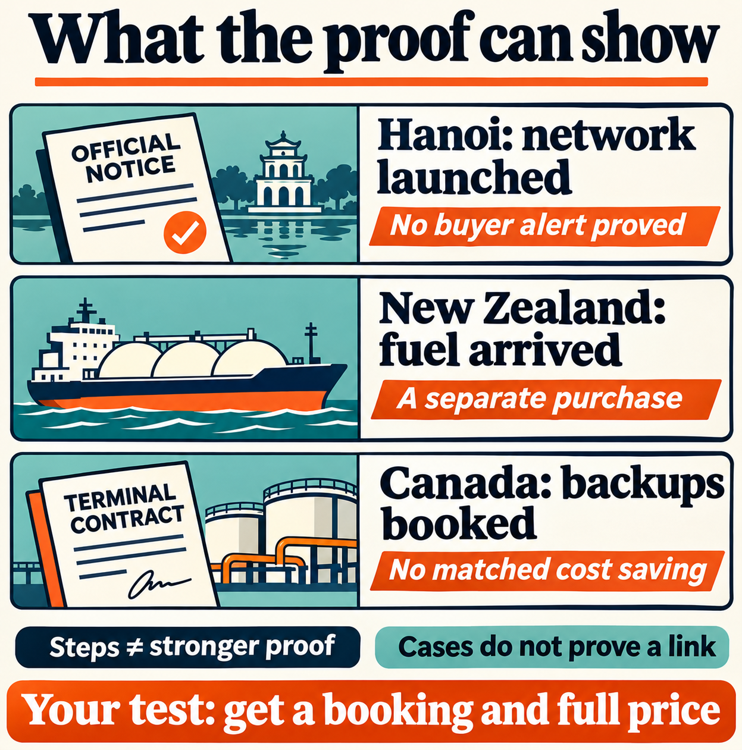
Read the image as text
Hanoi’s launch proves an official network exists. No public buyer alert is verified. The New Zealand record establishes that a separate reserve shipment arrived; it does not show how a particular government warning changed the order. Canada’s inquiry describes alternate terminal arrangements, but there is no matched record of cost saved. A path with more steps is not stronger proof. For your cargo, ask for confirmed space, a delivery date and the full route price.
- 19 Jul 2023 · CanadaCanpotex withdraws new potash sales offers during Vancouver’s disruption. Its later letter records greater reliance on US ports, not a complete replacement route.
- 20 Nov 2025 · AustraliaThe first EU–CPTPP trade dialogue names supply chain resilience as a priority.
- 15 Nov 2026 · terms in preparationThe Austrian Parliament’s public register lists a working paper about the network’s terms. The entry does not tell small buyers how to receive a warning.
- 26 Nov 2026 · HanoiTrade partners launch a network for officials. Local coverage records the morning agreement by 11:44 a.m. SGT, not the exact launch or European posting minute.
- 15 Dec 2026 · 10 p.m. SGTThe Commission plans a 90-minute debrief. Ask whether there will be a contact or public notice for businesses.
- Early 2027 · date not announcedExpected first meeting of the network. Do not count it as the first alert.
Evidence and sources for What is known, and what comes next
- 19 Jul 2023 · Canada Canpotex withdraws new potash sales offers during Vancouver’s disruption. Its later letter records greater reliance on US ports, not a complete replacement route. · Canpotex via Parliament of Canada · Letter dated 12 Dec 2023 (date only): Canpotex 12 December letter on route reliance and sales offers after Vancouver disruption
- 20 Nov 2025 · Australia The first EU–CPTPP trade dialogue names supply chain resilience as a priority. · European Commission · 20 Nov 2025 (date only): First EU–CPTPP Trade and Investment Dialogue
- 15 Nov 2026 · terms in preparation The Austrian Parliament’s public register lists a working paper about the network’s terms. The entry does not tell small buyers how to receive a warning. · Austrian Parliament · Working paper created 15 Nov 2026, registered as received 16 Nov; dates only: Public register entry for the network terms-of-reference working paper WK 17757/26
- 26 Nov 2026 · Hanoi Trade partners launch a network for officials. Local coverage records the morning agreement by 11:44 a.m. SGT, not the exact launch or European posting minute. · European Commission · 26 Nov 2026 (date only): Hanoi network launch and planned first meeting · Báo Công Thương (Vietnam Industry and Trade newspaper) · 26 Nov 2026, 10:44 ICT (11:44 SGT); coverage time, not exact launch time: On-location photographs and report of the Hanoi morning meeting
- 15 Dec 2026 · 10 p.m. SGT The Commission plans a 90-minute debrief. Ask whether there will be a contact or public notice for businesses. · European Commission · Event scheduled for 15 Dec 2026, 15:00–16:30 CET; posting time not stated: Civil-society debrief on the Hanoi dialogue
- Early 2027 · date not announced Expected first meeting of the network. Do not count it as the first alert. · European Commission · 26 Nov 2026 (date only): Hanoi network launch and planned first meeting
- New Zealand · prove that the goods arrivedThe fuel partnership identified other routes. A separate reserve purchase records a first diesel load on 31 May and an arrival confirmed by 7 July. The records do not link that shipment to the partnership.
- British Columbia · prove the right space is availableSome US terminals secured longer contracts. In July 2023, Shanghai-to-Toronto containers took about 43 days via either port. The official report’s prose and table disagree on which was quicker. Neither measures time saved by diverting.
- Canpotex · check whether the supplier still offersThe bulk potash exporter said it relied more on US ports but withdrew new sales offers on 19 July. There is no proof it used the same terminals or contracts as the container shippers.
Evidence and sources for Two paths between a warning and a lost offer
- New Zealand · prove that the goods arrived The fuel partnership identified other routes. A separate reserve purchase records a first diesel load on 31 May and an arrival confirmed by 7 July. The records do not link that shipment to the partnership. · New Zealand Ministry of Foreign Affairs and Trade · Report signed 29 Sep 2026; precise online publication date not established: 2025–26 annual report, p. 30: partners identified alternate fuel supply routes · New Zealand Government · 1 Jun 2026 (date only): First reserve diesel consignment loaded on 31 May · New Zealand Government · 7 Jul 2026 (date only; exact arrival date not stated): Marsden Point tanks in use; first reserve diesel arrival confirmed
- British Columbia · prove the right space is available Some US terminals secured longer contracts. In July 2023, Shanghai-to-Toronto containers took about 43 days via either port. The official report’s prose and table disagree on which was quicker. Neither measures time saved by diverting. · Canada Industrial Inquiry Commission · Report submitted 8 May 2025 (date only): West Coast ports final report, section 9 and footnote 47 · British Columbia Maritime Employers Association via Parliament of Canada · Brief to 2023 committee study; posting date not stated: Port employers' original committee evidence on diversions and US terminal contracts · Transport Canada · 2023 reporting year; 2024 annual report: 2023 transport data: Shanghai–Toronto container transit times through British Columbia
- Canpotex · check whether the supplier still offers The bulk potash exporter said it relied more on US ports but withdrew new sales offers on 19 July. There is no proof it used the same terminals or contracts as the container shippers. · Canpotex via Parliament of Canada · Letter dated 12 Dec 2023 (date only): Canpotex 12 December letter on route reliance and sales offers after Vancouver disruption · Canada Industrial Inquiry Commission · Report submitted 8 May 2025 (date only): West Coast ports final report, section 9 and footnote 47
- 1. Check the warningFind the issuer, date, route and cargo covered. Check whether your supplier is still offering the goods on the same terms.
- 2. Confirm the whole tripAsk for the carrier, reserved space, transfer to truck or rail, delivery window and full extra charge. A port change is not necessarily a faster delivery.
- 3. Price what the switch can really preventIllustration only: if switching costs S$600 and avoids an S$800 loss, the difference is S$200 in your favour. If it avoids only S$250, switching costs you S$350 more. Confirm the real cost and delivery date first.
Evidence and sources for Before you pay to change a route
- 1. Check the warning Find the issuer, date, route and cargo covered. Check whether your supplier is still offering the goods on the same terms. · European Commission · 26 Nov 2026 (date only): Hanoi network launch and planned first meeting · Canpotex via Parliament of Canada · Letter dated 12 Dec 2023 (date only): Canpotex 12 December letter on route reliance and sales offers after Vancouver disruption
- 2. Confirm the whole trip Ask for the carrier, reserved space, transfer to truck or rail, delivery window and full extra charge. A port change is not necessarily a faster delivery. · Canada Industrial Inquiry Commission · Report submitted 8 May 2025 (date only): West Coast ports final report, section 9 and footnote 47 · Transport Canada · 2023 reporting year; 2024 annual report: 2023 transport data: Shanghai–Toronto container transit times through British Columbia
- 3. Price what the switch can really prevent Illustration only: if switching costs S$600 and avoids an S$800 loss, the difference is S$200 in your favour. If it avoids only S$250, switching costs you S$350 more. Confirm the real cost and delivery date first. · New Zealand Government · 7 Jul 2026 (date only; exact arrival date not stated): Marsden Point tanks in use; first reserve diesel arrival confirmed · Transport Canada · 2023 reporting year; 2024 annual report: 2023 transport data: Shanghai–Toronto container transit times through British Columbia
03 · Story map
Map view
Main path · Hanoi network launch compared with New Zealand’s diesel delivery and Canpotex’s withdrawal of new offers
1 pivot · 2 links · New Zealand looks for fuel routes and separately buys reserve diesel
- Unproven: EU and Pacific trade partners launch a warning network → New Zealand looks for fuel routes and separately buys reserve dieselPivot 1: New Zealand looks for fuel routes and separately buys reserve diesel
- Unproven: New Zealand looks for fuel routes and separately buys reserve diesel → Canpotex withdraws new potash sales offers
Alternate path · Hanoi network launch compared with US terminal contracts and Canpotex’s withdrawal of new offers
1 pivot · 2 links · US terminals make longer agreements during Canadian port disruption
- Unproven: EU and Pacific trade partners launch a warning network → US terminals make longer agreements during Canadian port disruptionPivot 1: US terminals make longer agreements during Canadian port disruption
- Unproven: US terminals make longer agreements during Canadian port disruption → Canpotex withdraws new potash sales offers
Main path · Hanoi network launch compared with New Zealand’s diesel delivery and Canpotex’s withdrawal of new offers
1 pivot · 2 links · New Zealand looks for fuel routes and separately buys reserve diesel
- Start EU and Pacific trade partners launch a warning network
Unproven: EU and Pacific trade partners launch a warning network → New Zealand looks for fuel routes and separately buys reserve diesel
- Who and when
- European Commission; New Zealand foreign ministry · 26 Nov 2026; 31 Mar to 7 Jul 2026 comparison
- What the evidence shows
- Hanoi plans official warnings. A separate fuel partnership involving New Zealand shows that officials can identify other routes while a disruption is unfolding.
- What it does not show
- No record shows Hanoi copied the fuel response or sent an alert to an importer.
- What weakens the link
- Even identifying possible routes does not show an available shipment or a confirmed recipient.
- Next check
- Check the 15 December debrief for the first recipients, what the warnings cover and how businesses can see them.
- European Commission · 26 Nov 2026 (date only): Hanoi network launch and planned first meeting
- European Commission · Event scheduled for 15 Dec 2026, 15:00–16:30 CET; posting time not stated: Civil-society debrief on the Hanoi dialogue
- Austrian Parliament · Working paper created 15 Nov 2026, registered as received 16 Nov; dates only: Public register entry for the network terms-of-reference working paper WK 17757/26
- Báo Công Thương (Vietnam Industry and Trade newspaper) · 26 Nov 2026, 10:44 ICT (11:44 SGT); coverage time, not exact launch time: On-location photographs and report of the Hanoi morning meeting
- New Zealand Ministry of Foreign Affairs and Trade · 31 Mar 2026 (date only): FIT Partnership agrees to share information and coordinate disruption responses
- New Zealand Ministry of Foreign Affairs and Trade · Report signed 29 Sep 2026; precise online publication date not established: 2025–26 annual report, p. 30: partners identified alternate fuel supply routes
- Pivot 1 New Zealand looks for fuel routes and separately buys reserve diesel
Unproven: New Zealand looks for fuel routes and separately buys reserve diesel → Canpotex withdraws new potash sales offers
- Who and when
- New Zealand ministers; Z Energy; Canpotex · 31 May–7 Jul 2026 compared with 19 Jul 2023
- What the evidence shows
- A separate New Zealand state purchase is documented at loading and arrival. Canpotex’s decision shows why a buyer needs that kind of follow-through, not just news that a backup exists.
- What it does not show
- Reserve diesel is not bulk fertiliser. Neither response proves what the other could have done, and the diesel delivery is not attributed to the fuel partnership.
- What weakens the link
- A government can organise tanks and a large order. A small business may not have that option.
- Next check
- Look for dated evidence of loading and receipt for the exact goods before treating a replacement shipment as complete.
- New Zealand Ministry of Foreign Affairs and Trade · Report signed 29 Sep 2026; precise online publication date not established: 2025–26 annual report, p. 30: partners identified alternate fuel supply routes
- New Zealand Government · 1 Jun 2026 (date only): First reserve diesel consignment loaded on 31 May
- New Zealand Government · 7 Jul 2026 (date only; exact arrival date not stated): Marsden Point tanks in use; first reserve diesel arrival confirmed
- Canpotex via Parliament of Canada · Letter dated 12 Dec 2023 (date only): Canpotex 12 December letter on route reliance and sales offers after Vancouver disruption
- End Canpotex withdraws new potash sales offers
Alternate path · Hanoi network launch compared with US terminal contracts and Canpotex’s withdrawal of new offers
1 pivot · 2 links · US terminals make longer agreements during Canadian port disruption
- Start EU and Pacific trade partners launch a warning network
Unproven: EU and Pacific trade partners launch a warning network → US terminals make longer agreements during Canadian port disruption
- Who and when
- European Commission; Canadian port inquiry · 26 Nov 2026; Jul–Sep 2023 comparison
- What the evidence shows
- Hanoi aims to coordinate responses. The Canadian inquiry gives an example of a different response: US terminals agreeing to take container traffic under longer contracts.
- What it does not show
- No evidence links those contracts to Hanoi or to a warning from this network.
- What weakens the link
- Some vessel services were still cancelled, and changing ports can add road, rail or storage costs.
- Next check
- Check whether a future alert identifies a usable route and is followed by a named carrier’s dated confirmation of space.
- European Commission · 26 Nov 2026 (date only): Hanoi network launch and planned first meeting
- Canada Industrial Inquiry Commission · Report submitted 8 May 2025 (date only): West Coast ports final report, section 9 and footnote 47
- British Columbia Maritime Employers Association via Parliament of Canada · Brief to 2023 committee study; posting date not stated: Port employers' original committee evidence on diversions and US terminal contracts
- Transport Canada · 2023 reporting year; 2024 annual report: 2023 transport data: Shanghai–Toronto container transit times through British Columbia
- Pivot 1 US terminals make longer agreements during Canadian port disruption
Unproven: US terminals make longer agreements during Canadian port disruption → Canpotex withdraws new potash sales offers
- Who and when
- US terminal operators; Canpotex · 19 Jul 2023 against Jul–Sep 2023 container service evidence
- What the evidence shows
- Two records from the same disruption show different results. Some container shippers secured longer agreements. A bulk fertiliser exporter said it used US ports more but withdrew new sales offers.
- What it does not show
- There is no evidence Canpotex used those same terminal contracts, or that its new offers would have stayed open with a different arrangement.
- What weakens the link
- Canpotex said its other Canadian options were already heavily used. A port that takes containers may not be set up to handle this bulk cargo.
- Next check
- Confirm the exact cargo, who is willing to carry it, the onward route and whether the supplier still stands behind the arrival date.
- Canada Industrial Inquiry Commission · Report submitted 8 May 2025 (date only): West Coast ports final report, section 9 and footnote 47
- British Columbia Maritime Employers Association via Parliament of Canada · Brief to 2023 committee study; posting date not stated: Port employers' original committee evidence on diversions and US terminal contracts
- Canpotex via Parliament of Canada · Letter dated 12 Dec 2023 (date only): Canpotex 12 December letter on route reliance and sales offers after Vancouver disruption
- End Canpotex withdraws new potash sales offers
Read view
Main path · Hanoi network launch compared with New Zealand’s diesel delivery and Canpotex’s withdrawal of new offers
1 pivot · 2 links · New Zealand looks for fuel routes and separately buys reserve diesel
Unproven: EU and Pacific trade partners launch a warning network → New Zealand looks for fuel routes and separately buys reserve diesel
- Who and when
- European Commission; New Zealand foreign ministry · 26 Nov 2026; 31 Mar to 7 Jul 2026 comparison
- What the evidence shows
- Hanoi plans official warnings. A separate fuel partnership involving New Zealand shows that officials can identify other routes while a disruption is unfolding.
- What it does not show
- No record shows Hanoi copied the fuel response or sent an alert to an importer.
- What weakens the link
- Even identifying possible routes does not show an available shipment or a confirmed recipient.
- Next check
- Check the 15 December debrief for the first recipients, what the warnings cover and how businesses can see them.
- European Commission · 26 Nov 2026 (date only): Hanoi network launch and planned first meeting
- European Commission · Event scheduled for 15 Dec 2026, 15:00–16:30 CET; posting time not stated: Civil-society debrief on the Hanoi dialogue
- Austrian Parliament · Working paper created 15 Nov 2026, registered as received 16 Nov; dates only: Public register entry for the network terms-of-reference working paper WK 17757/26
- Báo Công Thương (Vietnam Industry and Trade newspaper) · 26 Nov 2026, 10:44 ICT (11:44 SGT); coverage time, not exact launch time: On-location photographs and report of the Hanoi morning meeting
- New Zealand Ministry of Foreign Affairs and Trade · 31 Mar 2026 (date only): FIT Partnership agrees to share information and coordinate disruption responses
- New Zealand Ministry of Foreign Affairs and Trade · Report signed 29 Sep 2026; precise online publication date not established: 2025–26 annual report, p. 30: partners identified alternate fuel supply routes
Unproven: New Zealand looks for fuel routes and separately buys reserve diesel → Canpotex withdraws new potash sales offers
- Who and when
- New Zealand ministers; Z Energy; Canpotex · 31 May–7 Jul 2026 compared with 19 Jul 2023
- What the evidence shows
- A separate New Zealand state purchase is documented at loading and arrival. Canpotex’s decision shows why a buyer needs that kind of follow-through, not just news that a backup exists.
- What it does not show
- Reserve diesel is not bulk fertiliser. Neither response proves what the other could have done, and the diesel delivery is not attributed to the fuel partnership.
- What weakens the link
- A government can organise tanks and a large order. A small business may not have that option.
- Next check
- Look for dated evidence of loading and receipt for the exact goods before treating a replacement shipment as complete.
- New Zealand Ministry of Foreign Affairs and Trade · Report signed 29 Sep 2026; precise online publication date not established: 2025–26 annual report, p. 30: partners identified alternate fuel supply routes
- New Zealand Government · 1 Jun 2026 (date only): First reserve diesel consignment loaded on 31 May
- New Zealand Government · 7 Jul 2026 (date only; exact arrival date not stated): Marsden Point tanks in use; first reserve diesel arrival confirmed
- Canpotex via Parliament of Canada · Letter dated 12 Dec 2023 (date only): Canpotex 12 December letter on route reliance and sales offers after Vancouver disruption
Alternate path · Hanoi network launch compared with US terminal contracts and Canpotex’s withdrawal of new offers
1 pivot · 2 links · US terminals make longer agreements during Canadian port disruption
Unproven: EU and Pacific trade partners launch a warning network → US terminals make longer agreements during Canadian port disruption
- Who and when
- European Commission; Canadian port inquiry · 26 Nov 2026; Jul–Sep 2023 comparison
- What the evidence shows
- Hanoi aims to coordinate responses. The Canadian inquiry gives an example of a different response: US terminals agreeing to take container traffic under longer contracts.
- What it does not show
- No evidence links those contracts to Hanoi or to a warning from this network.
- What weakens the link
- Some vessel services were still cancelled, and changing ports can add road, rail or storage costs.
- Next check
- Check whether a future alert identifies a usable route and is followed by a named carrier’s dated confirmation of space.
- European Commission · 26 Nov 2026 (date only): Hanoi network launch and planned first meeting
- Canada Industrial Inquiry Commission · Report submitted 8 May 2025 (date only): West Coast ports final report, section 9 and footnote 47
- British Columbia Maritime Employers Association via Parliament of Canada · Brief to 2023 committee study; posting date not stated: Port employers' original committee evidence on diversions and US terminal contracts
- Transport Canada · 2023 reporting year; 2024 annual report: 2023 transport data: Shanghai–Toronto container transit times through British Columbia
Unproven: US terminals make longer agreements during Canadian port disruption → Canpotex withdraws new potash sales offers
- Who and when
- US terminal operators; Canpotex · 19 Jul 2023 against Jul–Sep 2023 container service evidence
- What the evidence shows
- Two records from the same disruption show different results. Some container shippers secured longer agreements. A bulk fertiliser exporter said it used US ports more but withdrew new sales offers.
- What it does not show
- There is no evidence Canpotex used those same terminal contracts, or that its new offers would have stayed open with a different arrangement.
- What weakens the link
- Canpotex said its other Canadian options were already heavily used. A port that takes containers may not be set up to handle this bulk cargo.
- Next check
- Confirm the exact cargo, who is willing to carry it, the onward route and whether the supplier still stands behind the arrival date.
- Canada Industrial Inquiry Commission · Report submitted 8 May 2025 (date only): West Coast ports final report, section 9 and footnote 47
- British Columbia Maritime Employers Association via Parliament of Canada · Brief to 2023 committee study; posting date not stated: Port employers' original committee evidence on diversions and US terminal contracts
- Canpotex via Parliament of Canada · Letter dated 12 Dec 2023 (date only): Canpotex 12 December letter on route reliance and sales offers after Vancouver disruption
Research workspace
How the Evidence Connects
- EU and Pacific trade partners launch a warning network → New Zealand looks for fuel routes and separately buys reserve diesel (Unproven): Hanoi plans official warnings. A separate fuel partnership involving New Zealand shows that officials can identify other routes while a disruption is unfolding. Limit: No record shows Hanoi copied the fuel response or sent an alert to an importer.
- European Commission · 26 Nov 2026 (date only): Hanoi network launch and planned first meeting
- European Commission · Event scheduled for 15 Dec 2026, 15:00–16:30 CET; posting time not stated: Civil-society debrief on the Hanoi dialogue
- Austrian Parliament · Working paper created 15 Nov 2026, registered as received 16 Nov; dates only: Public register entry for the network terms-of-reference working paper WK 17757/26
- Báo Công Thương (Vietnam Industry and Trade newspaper) · 26 Nov 2026, 10:44 ICT (11:44 SGT); coverage time, not exact launch time: On-location photographs and report of the Hanoi morning meeting
- New Zealand Ministry of Foreign Affairs and Trade · 31 Mar 2026 (date only): FIT Partnership agrees to share information and coordinate disruption responses
- New Zealand Ministry of Foreign Affairs and Trade · Report signed 29 Sep 2026; precise online publication date not established: 2025–26 annual report, p. 30: partners identified alternate fuel supply routes
- New Zealand looks for fuel routes and separately buys reserve diesel → Canpotex withdraws new potash sales offers (Unproven): A separate New Zealand state purchase is documented at loading and arrival. Canpotex’s decision shows why a buyer needs that kind of follow-through, not just news that a backup exists. Limit: Reserve diesel is not bulk fertiliser. Neither response proves what the other could have done, and the diesel delivery is not attributed to the fuel partnership.
- New Zealand Ministry of Foreign Affairs and Trade · Report signed 29 Sep 2026; precise online publication date not established: 2025–26 annual report, p. 30: partners identified alternate fuel supply routes
- New Zealand Government · 1 Jun 2026 (date only): First reserve diesel consignment loaded on 31 May
- New Zealand Government · 7 Jul 2026 (date only; exact arrival date not stated): Marsden Point tanks in use; first reserve diesel arrival confirmed
- Canpotex via Parliament of Canada · Letter dated 12 Dec 2023 (date only): Canpotex 12 December letter on route reliance and sales offers after Vancouver disruption
Alternate: EU and Pacific trade partners launch a warning network → US terminals make longer agreements during Canadian port disruption → Canpotex withdraws new potash sales offers. Canpotex exported bulk fertiliser. The inquiry’s alternate-terminal contracts were for containers, and New Zealand’s diesel was bought for a national reserve. No source says those container deals included Canpotex or gave it enough room to keep offering new sales. These histories explain a bottleneck, not what the Hanoi network has done.
- Connection strength
- Two separate comparisons link the same news records. New Zealand shows what proof of delivery looks like; British Columbia tests which loads a backup can take. Neither establishes that Hanoi caused the earlier events or will prevent another withdrawal.
- Source credibility
- European Commission launch and debrief records, New Zealand government records, Canada’s port inquiry and Transport Canada, and Canpotex’s dated letter to Parliament. The port-call counts are from port employers.
- Reader relevance
- If your supplier stops offering new orders, check whether your own order and delivery date are still confirmed before paying someone else.
- Confidence
- High in the documented launch and offer withdrawal. Unknown whether an official warning reaches a business in time or secures space for its cargo.
OTR Emerging Data
An early warning can help you plan, but it cannot keep goods moving on its own. Canpotex’s July decision shows a buyer can lose access to new offers even when some alternatives exist. For a small business, the better comparison is not port versus port. Compare two offers for your exact goods and destination, and ask which one the supplier can still honour by the date you need.
What to check next
On 15 December 2026 the European Commission plans a civil-society debrief from 3 to 4:30 p.m. in Brussels (10 to 11:30 p.m. in Singapore). This is a debrief, not the first network meeting or a promise to issue an alert. Look for a public document identifying who receives warnings and how they reach businesses. For an operational test, look for a dated warning followed by a dated carrier change for a covered route. Separately check whether the cargo actually arrived.
Ask your supplier whether they are still offering the exact goods and delivery date. If not, ask your freight broker for a written backup with confirmed space, the full cost, an arrival window and the last time you can book. Agree in advance what would make you switch.
If the supplier withdraws new offers or the backup misses your deadline, confirm any existing order separately and ask what can still be supplied. If the exact goods, space, price and date are confirmed in writing, compare the real cost of switching with the loss you can avoid.
Original sources
- European Commission · 26 Nov 2026 (date only): Hanoi network launch and planned first meeting
- European Commission · 20 Nov 2025 (date only): First EU–CPTPP Trade and Investment Dialogue
- European Commission · Event scheduled for 15 Dec 2026, 15:00–16:30 CET; posting time not stated: Civil-society debrief on the Hanoi dialogue
- New Zealand Ministry of Foreign Affairs and Trade · 31 Mar 2026 (date only): FIT Partnership agrees to share information and coordinate disruption responses
- New Zealand Ministry of Foreign Affairs and Trade · Report signed 29 Sep 2026; precise online publication date not established: 2025–26 annual report, p. 30: partners identified alternate fuel supply routes
- New Zealand Government · 1 Jun 2026 (date only): First reserve diesel consignment loaded on 31 May
- New Zealand Government · 7 Jul 2026 (date only; exact arrival date not stated): Marsden Point tanks in use; first reserve diesel arrival confirmed
- Canada Industrial Inquiry Commission · Report submitted 8 May 2025 (date only): West Coast ports final report, section 9 and footnote 47
- British Columbia Maritime Employers Association via Parliament of Canada · Brief to 2023 committee study; posting date not stated: Port employers' original committee evidence on diversions and US terminal contracts
- Transport Canada · 2023 reporting year; 2024 annual report: 2023 transport data: Shanghai–Toronto container transit times through British Columbia
- Báo Công Thương (Vietnam Industry and Trade newspaper) · 26 Nov 2026, 10:44 ICT (11:44 SGT); coverage time, not exact launch time: On-location photographs and report of the Hanoi morning meeting
- Austrian Parliament · Working paper created 15 Nov 2026, registered as received 16 Nov; dates only: Public register entry for the network terms-of-reference working paper WK 17757/26
- Canpotex via Parliament of Canada · Letter dated 12 Dec 2023 (date only): Canpotex 12 December letter on route reliance and sales offers after Vancouver disruption