OnTheRice · News Degrees
Singapore and Australia signed a deal to store carbon under the seabed. What still has to happen?
See how four years of talks and rule changes led to the signing, and what to check before calling it a working route.
In 2022, Singapore and Australia agreed to explore sending captured carbon dioxide across borders for storage. On 24 November 2026, they signed a separate agreement. It does not approve a shipment or a storage site.
Degrees count the stories between the endpoints. Strength tells you how well the evidence supports each link.
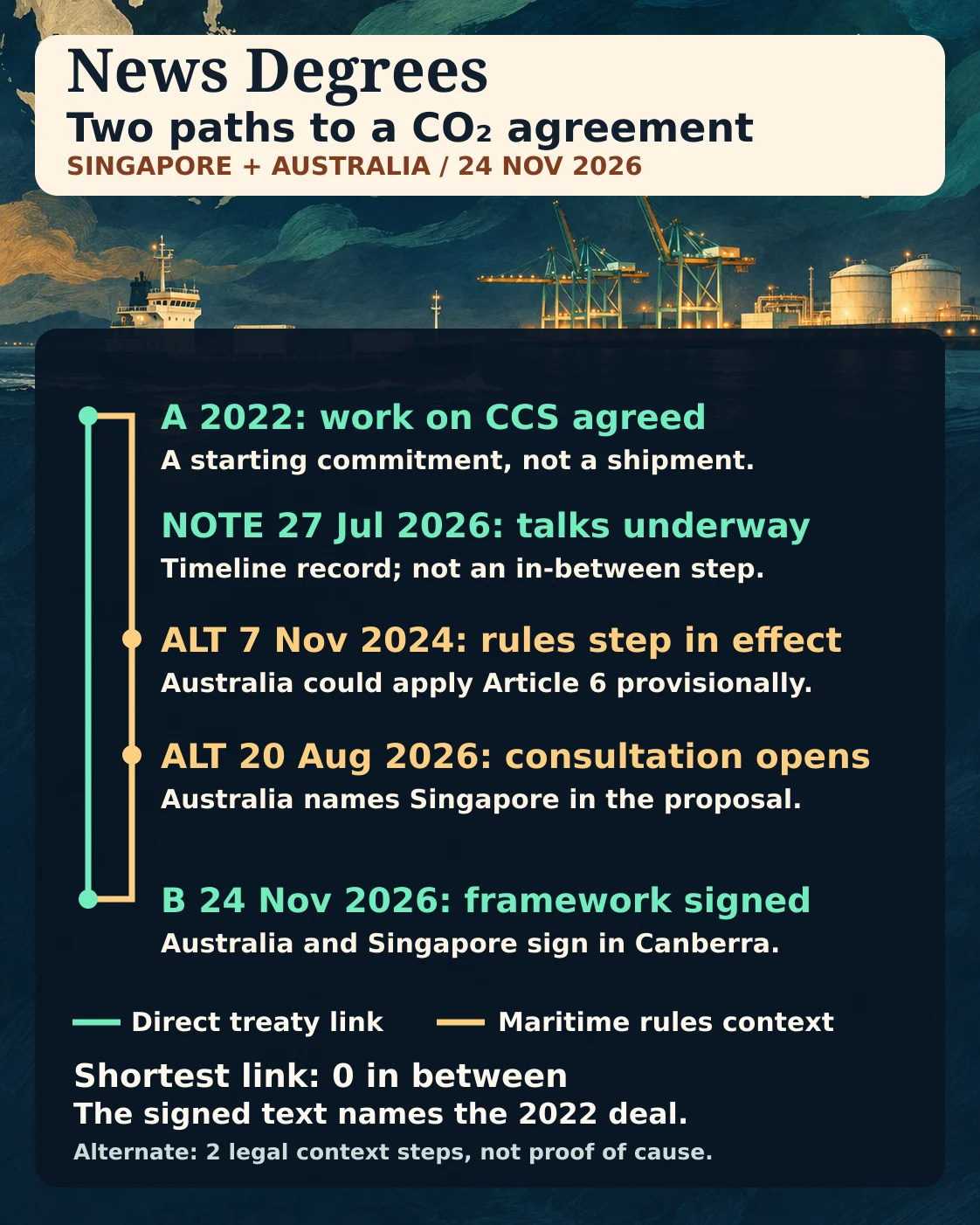
Read the image as text
The shortest route has no records in between: the signed 24 November text expressly refers to the 2022 deal. The 27 July talks are dated supporting history. The alternate follows two in-between records: Australia applies the international export rule, then asks the public about a Singapore agreement. The first alternate link documents legal context, not what caused Australia’s international filing.
Documented (solid) Unproven (dashed)
01 · Read the records
Singapore and Australia agree to explore cross-border carbon storage
2022-10-18
The two countries signed a broad Green Economy Agreement in Canberra. Its clean energy section names cross-border carbon capture and storage as a topic to explore.
Shows when the idea entered the written agreement.
Ministers report formal talks are underway
2026-07-27
Ministers in Adelaide said formal negotiations were underway for a legally binding agreement to move carbon dioxide for storage beneath the seabed.
Names the specific offshore agreement the two countries were discussing.
Australia provisionally applies the international export rule
Declaration received 2024-10-28; effective 2024-11-07
The international depositary records receipt on 28 October and effect from 7 November. The rule allows participating countries to use the amended London Protocol route subject to its safeguards and an agreement or arrangement between the countries concerned.
Explains the legal route Australia could use; the filing did not name Singapore.
Australia seeks feedback on the Singapore instrument
Consultation 2026-08-20 to 2026-09-11
Australia ran a public consultation naming Singapore. It described the international rule and said a separate instrument must be in place before the activity can occur.
Shows how Australia explained the rule in a Singapore-specific public consultation.
Singapore and Australia sign the cross-border carbon storage agreement
2026-11-24 Canberra; no signing hour verified
The governments signed the text, which recalls both the Green Economy Agreement and the London Protocol. Article 11 says it takes effect on the 30th calendar day after the last written diplomatic notice of completed procedures.
Confirms signature and gives the separate test for the agreement to take effect.
02 · Where the evidence stops
- Supports the chain
- Sending captured carbon dioxide overseas for storage takes more than finding a place to put it. In October 2022, Singapore and Australia named it as something to explore. By July 2026, ministers said formal talks were underway. A different set of records shows Australia applying an international rule and asking the public about a Singapore agreement. The countries signed that separate agreement on 24 November 2026.
- Weakens the chain
- The signing does not tell us when the agreement takes effect, which company will use it, or which site will receive carbon dioxide. Article 11 sets a separate clock: both countries must notify each other after completing their procedures. The agreement starts 30 calendar days after the last notice. A specific project still needs the applicable approvals. We did not verify a notice date, an operating route, or any shipment under this agreement.
- Still missing
- No verified official start date, named project approval, or shipment under this agreement.
Our earlier Signal covered Bonaparte, a separate proposed project. This agreement does not name or approve a project. Read the Bonaparte Signal
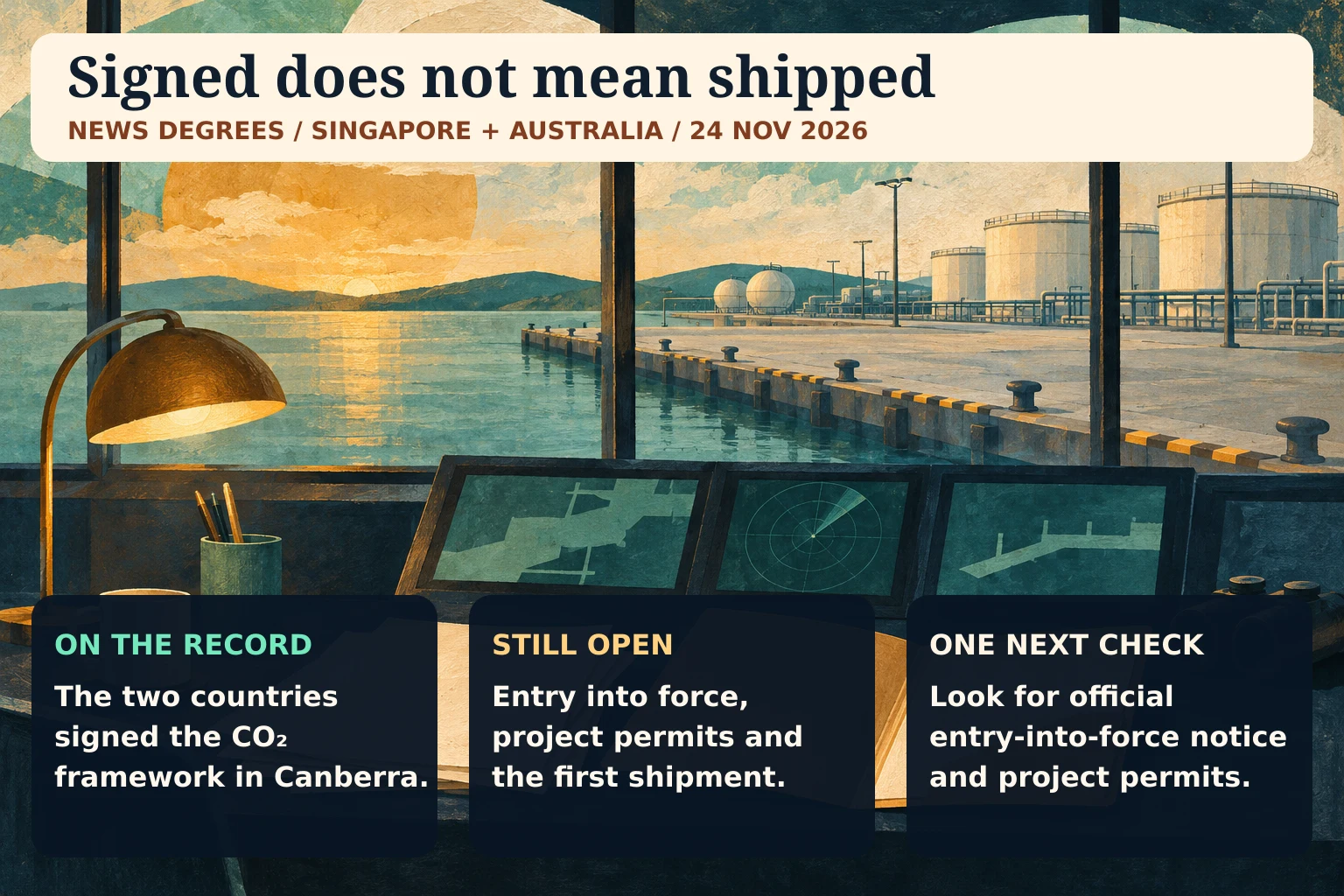
Read the image as text
The countries signed on 24 November 2026. Article 11 says the agreement takes effect 30 calendar days after the last written diplomatic notice. A specific project still needs applicable approvals. We have not confirmed the start date, a project permit or a shipment.
Dates that tell two stories
- 18 Oct 2022 · Both routes The governments name the idea in the Green Economy Agreement.
- 28 Oct and 7 Nov 2024 · Rules The IMO received Australia’s declaration on 28 October. It took effect on 7 November.
- 27 Jul 2026 · Talks Ministers say formal negotiations are underway.
- 20 Aug–11 Sep 2026 · Rules Australia asks for feedback on the Singapore-specific instrument.
- 24 Nov 2026 · Both routes The governments sign. No signing hour verified.
What each original record proves and where it stops
- The 2022 text and the July statement
- The governments explored the idea and later reported formal talks. The two records do not show what set the final terms.
- The IMO filing and Australian public consultation
- Australia had a legal route and asked about a Singapore instrument. That is not evidence the 2022 commitment caused the wider filing.
- International Maritime Organization, treaty depositary status update · Publication date not stated: Status of IMO conventions
- International Maritime Organization, London Protocol offshore CCS regulatory background · Publication date not stated: Offshore carbon capture and storage
- Australian Department of Climate Change, Energy, Environment and Water · Publication date not stated: Public consultation on the Australia–Singapore agreement
- The signed text
- It confirms signature and sets a separate start rule. It does not show an approval or shipment.
Can the named project ship now?
- 1 · Is the agreement signed? Yes. Signature alone is not a start date.
- 2 · Has it taken effect? Find the official start date. Article 11 sets a 30-calendar-day wait after the last diplomatic notice.
- 3 · Is the named project approved? Check that the regulator’s permit covers the exact project and activity. If either check is missing, do not call it ready.
03 · Story map
Map view
Main path · The direct treaty link
0 pivots · 1 link
- Documented: Singapore and Australia agree to explore cross-border carbon storage → Singapore and Australia sign the cross-border carbon storage agreement
Alternate path · The rule and public review track
2 pivots · 3 links · Australia provisionally applies the international export rule, Australia seeks feedback on the Singapore instrument
- Documented context; cause unproven: Singapore and Australia agree to explore cross-border carbon storage → Australia provisionally applies the international export rulePivot 1: Australia provisionally applies the international export rule
- Documented: Australia provisionally applies the international export rule → Australia seeks feedback on the Singapore instrumentPivot 2: Australia seeks feedback on the Singapore instrument
- Documented: Australia seeks feedback on the Singapore instrument → Singapore and Australia sign the cross-border carbon storage agreement
Main path · The direct treaty link
0 pivots · 1 link
- Start Singapore and Australia agree to explore cross-border carbon storage
Documented: Singapore and Australia agree to explore cross-border carbon storage → Singapore and Australia sign the cross-border carbon storage agreement
- Who and when
- Singapore and Australia; signed offshore carbon storage agreement · 18 Oct 2022 to 24 Nov 2026
- What the evidence shows
- The signed 2026 agreement expressly recalls the 2022 Green Economy Agreement. The original 2022 text lists cross-border carbon storage as work to explore.
- What it does not show
- That the 2022 commitment caused the signing, or that a project or shipment was approved.
- What weakens the link
- The 2022 text names a topic to explore. It is not the agreement signed in 2026 and does not set its start date.
- Next check
- Read the signed text’s reference to the 2022 agreement and compare its start rule in Article 11.
- End Singapore and Australia sign the cross-border carbon storage agreement
Alternate path · The rule and public review track
2 pivots · 3 links · Australia provisionally applies the international export rule, Australia seeks feedback on the Singapore instrument
- Start Singapore and Australia agree to explore cross-border carbon storage
Documented context; cause unproven: Singapore and Australia agree to explore cross-border carbon storage → Australia provisionally applies the international export rule
- Who and when
- Australia; the London Protocol rule for cross-border offshore storage · 18 Oct 2022; declaration received 28 Oct 2024, effective 7 Nov 2024
- What the evidence shows
- Australia’s international filing addressed an enabling rule relevant to the cross-border idea. The eventual agreement expressly refers to the filing framework.
- What it does not show
- That the Singapore exploration commitment caused the filing, or that this filing was specific to Singapore.
- What weakens the link
- The filing applies across potential arrangements, not just to Singapore.
- Next check
- Read what the signed agreement says about the London Protocol and compare it to the IMO record.
- Australian DFAT, signed Green Economy Agreement · Publication date not stated: Green Economy Agreement signed text
- International Maritime Organization, treaty depositary status update · Publication date not stated: Status of IMO conventions
- International Maritime Organization, London Protocol offshore CCS regulatory background · Publication date not stated: Offshore carbon capture and storage
- Australian DFAT, original bilateral text; Article 11 for entry · 2026-11-24: Australia–Singapore transboundary carbon storage agreement
- Pivot 1 Australia provisionally applies the international export rule
Documented: Australia provisionally applies the international export rule → Australia seeks feedback on the Singapore instrument
- Who and when
- Australia; Singapore-specific instrument under the London Protocol route · 2024 declaration to 20 Aug–11 Sep 2026 consultation
- What the evidence shows
- The Australian consultation directly explains why a Singapore agreement is needed under the international rule.
- What it does not show
- That consultation alone approved activity or met domestic permitting requirements.
- What weakens the link
- The department’s short date summary is less precise than the IMO depositary record; distinguish receipt from effect.
- Next check
- Read the consultation and depositary records; do not substitute a later summary for the filing date.
- International Maritime Organization, treaty depositary status update · Publication date not stated: Status of IMO conventions
- International Maritime Organization, London Protocol offshore CCS regulatory background · Publication date not stated: Offshore carbon capture and storage
- Australian Department of Climate Change, Energy, Environment and Water · Publication date not stated: Public consultation on the Australia–Singapore agreement
- Pivot 2 Australia seeks feedback on the Singapore instrument
Documented: Australia seeks feedback on the Singapore instrument → Singapore and Australia sign the cross-border carbon storage agreement
- Who and when
- Australia’s Singapore-specific public consultation and signed bilateral text · 20 Aug–11 Sep to 24 Nov 2026
- What the evidence shows
- Australia sought input on the Singapore instrument before the same governments signed that type of agreement.
- What it does not show
- Which comments changed a clause, that parliamentary scrutiny ended or that a permit was granted.
- What weakens the link
- An input process is not proof that any feedback shaped the outcome.
- Next check
- Check official parliamentary and treaty-status records for later procedures separately from the consultation.
- Australian Department of Climate Change, Energy, Environment and Water · Publication date not stated: Public consultation on the Australia–Singapore agreement
- Australian DFAT, original bilateral text; Article 11 for entry · 2026-11-24: Australia–Singapore transboundary carbon storage agreement
- Singapore Ministry of Energy, Trade and Industry · 2026-11-24: Singapore–Australia agreement on moving captured carbon dioxide for offshore storage
- End Singapore and Australia sign the cross-border carbon storage agreement
Read view
Main path · The direct treaty link
0 pivots · 1 link
Documented: Singapore and Australia agree to explore cross-border carbon storage → Singapore and Australia sign the cross-border carbon storage agreement
- Who and when
- Singapore and Australia; signed offshore carbon storage agreement · 18 Oct 2022 to 24 Nov 2026
- What the evidence shows
- The signed 2026 agreement expressly recalls the 2022 Green Economy Agreement. The original 2022 text lists cross-border carbon storage as work to explore.
- What it does not show
- That the 2022 commitment caused the signing, or that a project or shipment was approved.
- What weakens the link
- The 2022 text names a topic to explore. It is not the agreement signed in 2026 and does not set its start date.
- Next check
- Read the signed text’s reference to the 2022 agreement and compare its start rule in Article 11.
Alternate path · The rule and public review track
2 pivots · 3 links · Australia provisionally applies the international export rule, Australia seeks feedback on the Singapore instrument
Documented context; cause unproven: Singapore and Australia agree to explore cross-border carbon storage → Australia provisionally applies the international export rule
- Who and when
- Australia; the London Protocol rule for cross-border offshore storage · 18 Oct 2022; declaration received 28 Oct 2024, effective 7 Nov 2024
- What the evidence shows
- Australia’s international filing addressed an enabling rule relevant to the cross-border idea. The eventual agreement expressly refers to the filing framework.
- What it does not show
- That the Singapore exploration commitment caused the filing, or that this filing was specific to Singapore.
- What weakens the link
- The filing applies across potential arrangements, not just to Singapore.
- Next check
- Read what the signed agreement says about the London Protocol and compare it to the IMO record.
- Australian DFAT, signed Green Economy Agreement · Publication date not stated: Green Economy Agreement signed text
- International Maritime Organization, treaty depositary status update · Publication date not stated: Status of IMO conventions
- International Maritime Organization, London Protocol offshore CCS regulatory background · Publication date not stated: Offshore carbon capture and storage
- Australian DFAT, original bilateral text; Article 11 for entry · 2026-11-24: Australia–Singapore transboundary carbon storage agreement
Documented: Australia provisionally applies the international export rule → Australia seeks feedback on the Singapore instrument
- Who and when
- Australia; Singapore-specific instrument under the London Protocol route · 2024 declaration to 20 Aug–11 Sep 2026 consultation
- What the evidence shows
- The Australian consultation directly explains why a Singapore agreement is needed under the international rule.
- What it does not show
- That consultation alone approved activity or met domestic permitting requirements.
- What weakens the link
- The department’s short date summary is less precise than the IMO depositary record; distinguish receipt from effect.
- Next check
- Read the consultation and depositary records; do not substitute a later summary for the filing date.
- International Maritime Organization, treaty depositary status update · Publication date not stated: Status of IMO conventions
- International Maritime Organization, London Protocol offshore CCS regulatory background · Publication date not stated: Offshore carbon capture and storage
- Australian Department of Climate Change, Energy, Environment and Water · Publication date not stated: Public consultation on the Australia–Singapore agreement
Documented: Australia seeks feedback on the Singapore instrument → Singapore and Australia sign the cross-border carbon storage agreement
- Who and when
- Australia’s Singapore-specific public consultation and signed bilateral text · 20 Aug–11 Sep to 24 Nov 2026
- What the evidence shows
- Australia sought input on the Singapore instrument before the same governments signed that type of agreement.
- What it does not show
- Which comments changed a clause, that parliamentary scrutiny ended or that a permit was granted.
- What weakens the link
- An input process is not proof that any feedback shaped the outcome.
- Next check
- Check official parliamentary and treaty-status records for later procedures separately from the consultation.
- Australian Department of Climate Change, Energy, Environment and Water · Publication date not stated: Public consultation on the Australia–Singapore agreement
- Australian DFAT, original bilateral text; Article 11 for entry · 2026-11-24: Australia–Singapore transboundary carbon storage agreement
- Singapore Ministry of Energy, Trade and Industry · 2026-11-24: Singapore–Australia agreement on moving captured carbon dioxide for offshore storage
Research workspace
How the Evidence Connects
- Singapore and Australia agree to explore cross-border carbon storage → Singapore and Australia sign the cross-border carbon storage agreement (Documented): The signed 2026 agreement expressly recalls the 2022 Green Economy Agreement. The original 2022 text lists cross-border carbon storage as work to explore. Limit: That the 2022 commitment caused the signing, or that a project or shipment was approved.
Alternate: Singapore and Australia agree to explore cross-border carbon storage → Australia provisionally applies the international export rule → Australia seeks feedback on the Singapore instrument → Singapore and Australia sign the cross-border carbon storage agreement. The signing does not tell us when the agreement takes effect, which company will use it, or which site will receive carbon dioxide. Article 11 sets a separate clock: both countries must notify each other after completing their procedures. The agreement starts 30 calendar days after the last notice. A specific project still needs the applicable approvals. We did not verify a notice date, an operating route, or any shipment under this agreement.
- Connection strength
- Strong for the observed policy milestones; only contextual for the first rule-track link.
- Source credibility
- Signed texts, government statements and IMO depositary records support distinct parts of the chain. Repeats of the same announcement are not extra evidence.
- Reader relevance
- Helps readers, businesses and reporters distinguish a signed headline from an operating service.
- Confidence
- High for signature and treaty wording; no conclusion about force, a project, a price, or first shipment without later evidence.
OTR Emerging Data
The agreement builds a legal route for future deals. It does not make a carbon storage service ready to buy. Treat any claim that a shipment is ready as unproven until the agreement’s start date and the named project’s approvals can be checked separately.
What to check next
Can you verify both the official start date and a permit covering the exact project and activity?
If a project says it can now ship captured carbon dioxide from Singapore to Australia, ask for two records: the agreement’s official start date and the relevant permit for the project named in the claim. Look in the Australian EPA permit list and the official treaty record. If either is missing, do not describe the route as ready. If both appear, check whether the permit covers that named project and activity before changing the assessment.
If both appear, check what the permit covers before changing the assessment.
Original sources
- Australian DFAT, signed Green Economy Agreement · Publication date not stated: Green Economy Agreement signed text
- Australian Foreign Minister, Joint Communiqué paragraph 13 · 2026-07-27: 15th Singapore–Australia Joint Ministerial Committee communiqué
- International Maritime Organization, treaty depositary status update · Publication date not stated: Status of IMO conventions
- International Maritime Organization, London Protocol offshore CCS regulatory background · Publication date not stated: Offshore carbon capture and storage
- Australian Department of Climate Change, Energy, Environment and Water · Publication date not stated: Public consultation on the Australia–Singapore agreement
- Australian DFAT, original bilateral text; Article 11 for entry · 2026-11-24: Australia–Singapore transboundary carbon storage agreement
- Singapore Ministry of Energy, Trade and Industry · 2026-11-24: Singapore–Australia agreement on moving captured carbon dioxide for offshore storage
- Australian National EPA, sea dumping applications and permits · Publication date not stated: Sea dumping applications and permits
- Australian Department of Foreign Affairs and Trade, Australian Treaties Database · Publication date not stated: Australian Treaties Database